I haven’t written a blog since my best friend John passed away a few weeks ago. It’s hard to find the right words when the silence left behind feels louder than anything I could write. I always considered John to be my best friend, and I tried to be his best friend. There was plenty of competition, though—he treated all his friends as best friends. That was John. He didn’t ration affection. He didn’t play favorites. He made you feel like the center of the room, even when the room was full. And somehow, you believed it—because with John, it was true.
John lived in Long Beach, Long Island with his wife Margaret. In a twist worthy of a song lyric, he met his wife Margaret one night while we were out celebrating my birthday. They raised three remarkable children—Eileen, Andrea, and Johnny—each carrying forward a piece of his spirit. Eileen, who illustrated my children’s book, lives upstate with her husband Christopher and their two children, Jack and Nora. Andrea is a scientist, married to Mark, and together they’re devoted Phish fans. Johnny works behind the scenes on television stages and at Lincoln Center, a quiet craftsman in the world of performance.
John and I met in 1971 at the N.Y. Telephone Co. We bonded over music, mischief, and the kind of friendship that doesn’t need explaining. We played on the same Telephone Company softball team, The Newtown Suns. He loved Family and Friends, Baseball, Music, and Long Beach. One year, Eileen gave him a birthday gift that lit him up—a guest DJ spot on a radio station in Woodstock, NY. That was one of his best days. He was in his element, spinning tracks and stories like he’d been born for it.
We had plenty of great times together. I went to all his parties, and after I moved to Lancaster, he came out here a few times a year to cheer on the Lancaster Barnstormers with me.
I have dozens of CDs he made for me. I can listen to them and think about him, but nothing can replace him. John loved Baseball, especially the Yankees. So, now that he joins Willie, Mickey, and the Duke in a Field of Dreams somewhere, I’ll play this song for him.
Back in the day, our basement wasn’t just a hangout—it was a teenage Shangri-La with vinyl grooves, checkerboard tiles, and just enough parental distance to feel like we were living on the edge. My brother and I would head down there with our friends to spin records, swap stories, and—unbeknownst to each other—conduct covert operations involving Dad’s liquor cabinet.
We weren’t throwing wild parties or reenacting scenes from Animal House. No, our rebellion was more… artisanal. A sip here, a splash there. Just enough to feel like we were pulling off a heist worthy of a Saturday matinee. And we had a system: mark the bottle with a crayon, take your sample, top it off with water, and erase the evidence like a magician with a disappearing act. Genius, right?
Except we were both doing it. Independently and repeatedly. By the time Dad poured himself a highball, it had the alcohol level of a snowball. His bourbon gradually became as colorless as gin with less kick than a Shirley Temple.
Our parents were highball aficionados—elegant glassware, fizzy mixers, and drinks so gentle they could’ve been served at a toddler’s tea party. The real excitement came during neighborhood card nights. At our house, the games were quiet, strategic, and sober—unless someone brought beer, which we hadn’t yet figured out how to misappropriate. But when the party moved down the block to a neighbor’s house — That’s when the cards flew, the rules bent, and the laughter spilled into the street like a runaway keg. We could hear them singing from a block away, and we knew: those folks weren’t sipping watered-down whiskey.
It wasn’t until last month, during a visit with my brother, that we finally compared notes about our teenage years. We were mildly surprised that we’d been running parallel bootlegging operations like two competing moonshiners. We laughed until our ribs hurt—not just at the memory, but at the sheer absurdity of thinking we’d fooled anyone. Dad probably knew. Maybe he even preferred his bourbon with a splash of sibling sabotage and a twist of teenage ingenuity. Maybe he was glad nobody got rip-roaring drunk in our house.
I woke up not on a cushiony cloud of air but with a hardwood frame pressing against my arthritic hip. That’s to be expected occasionally from air beds, though, so I just rolled out of bed and looked for my air bed repair kit. While I wandered around the house looking for my repair kit, I recalled a fond memory.
It was 1980, and my marriage was on the rocks. We had been separated for three years, and Ginny wanted a divorce. I hesitated, and she sweetened the deal: “Sign the divorce papers, and I’ll take you on vacation to Jamaica.” I asked only one question: “Does the hotel have a pool?” She said yes. I signed.
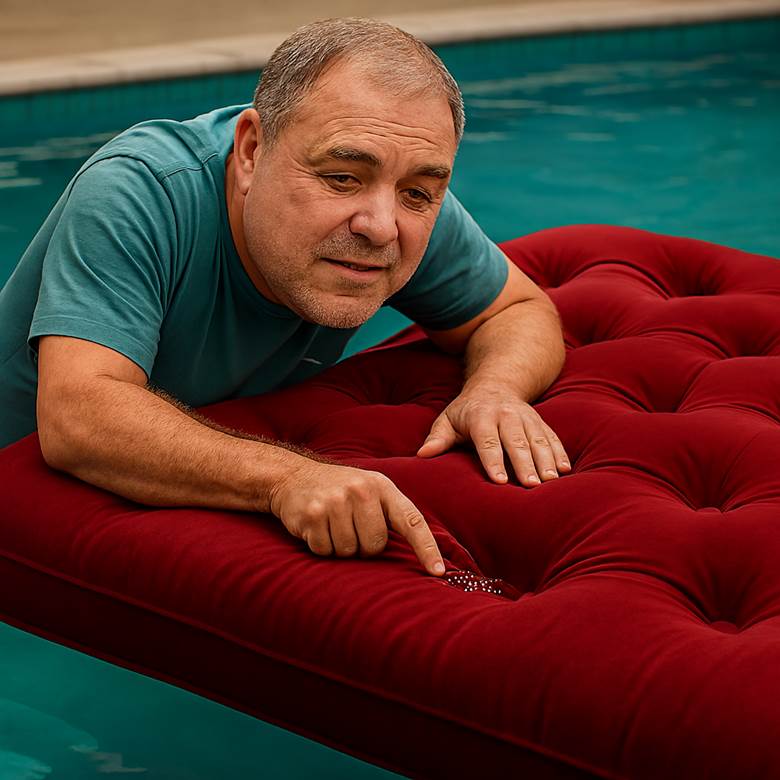
Now, this wasn’t just about tropical leisure. I had a mission. The king-sized airbed I slept on back then had recently sprung a leak, and every morning I woke up on hardwood instead of a heavenly cushion of air. I’d tried everything—soap bubbles, flashlight tests, even listening for whispers of escaping air. Nothing worked. I couldn’t find the leak, and if I couldn’t find it, I couldn’t fix it. But I had a plan: if I could get that bed into a pool, I could find the leak.
So I stuffed the deflated bed and a bathing suit into my suitcase and flew it to the Caribbean with Ginny.
Once we arrived, I inflated the beast and floated it in the hotel pool like a proud inventor testing his prototype. And there it was: the elusive leak, bubbling up like a confession. I patched it, let it dry, and suddenly we had a giant floating mattress perfect for ocean paddling. We spent the entire week drifting, laughing, and—somehow—rediscovering a spark. We even had sex regularly, which was more than we managed during the actual marriage.
We didn’t reconcile, but we did become friendly again. Divorce papers were still signed, but now we had a shared fresh memory of good times.
We were staying at a resort in Ocho Rios, the kind with orange rooftops, endless rum punch, and a view of a tiny offshore island crowned with a stone turret and three cabanas that looked like they’d been designed by a romantic pirate. Tower Isle, they called it. Clothing optional, they whispered.
We didn’t have a boat, but we had a big red airbed—tufted like a Victorian fainting couch and twice as ridiculous. We launched from the beach with the grace of two determined manatees, paddling with our hands and a sense of purpose that bordered on delusional.
The water was warm, the sun forgiving, and the raft surprisingly cooperative. Locals waved. Somewhere along the way, we invented synchronized paddling and declared ourselves the champions at it. We laughed so hard we nearly capsized.
Tower Isle loomed closer. The cabanas stood like sentinels. The tower watched us approach, unimpressed. We didn’t storm the beach so much as gently bump into it, while waving sheepishly at a couple who were decidedly less clothed than we were.
We didn’t stay long. Just long enough to say we’d been there, to feel the thrill of the forbidden, and to paddle back with sun-kissed shoulders and a story that would make us laugh for years.
Then came the airport.
Customs took one look at my deflated bed and raised an eyebrow. “What’s this?” “An airbed,” I said. “I brought it here to fix a leak.” They weren’t buying it. They wanted me to cut it open. “No way,” I said. “This bed and I have been through too much.” They insisted. I refused. I suggested drug-sniffing dogs. That’s when I felt a kick.
My ex-wife, now nervously jabbing me in the shin, whispered, “Just let them have it.” “No,” I said. “This is my bed. I love it. It’s finally not leaking. I’m not leaving it.” She kicked harder.
Eventually, customs gave up. They felt the bed, deemed it empty, and let us board. On the plane, I turned to her and asked, “Why were you kicking me?” She confessed that she had two ounces of pot tucked into her bra and was terrified the dogs would sniff her out. I was defending my mattress like a knight guarding a castle, while she was praying the hounds wouldn’t sniff her stash.
I laughed. She didn’t.
And that, dear reader, was my divorceamoon in Jamaica: a week of patching things—beds and relationships. I came home with a fixed airbed, a friendlier ex-wife, and a story that’s been floating around ever since.
Her birthday was last week, but I didn’t send her a card, because I don’t know where she lives. I haven’t heard from her in over a decade, but I still remember that the best vacation of my life was on our Divorceamoon.
We were taught to respect him. He wore a tie to breakfast. He had opinions on everything from foreign policy to potato salad. He shook his head at protests, praised moderation, and told stories where he was always the hero.
He was The Adult in the Room.
He built systems that favored the seasoned and the serious. He spoke in spreadsheets and nostalgia, mistaking legacy for wisdom. He said youth should “wait their turn,” even as the clock ticked toward irreversible climate change, social fracture, and another news cycle full of grief.
When the world caught fire, The Adult offered a lecture. When the oceans rose, he proposed a committee. When children cried out in fear or fury, he complimented their passion… and resumed business as usual.
But then something shifted.
It started small—barely audible under the weight of legacy. A 14-year-old refused to buy another plastic bottle. A class of 10-year-olds planted trees where asphalt had smothered their playground. Teens organized online, flooding streets not with rage, but with resolve. No party lines. No lobbyists. Just clarity.
They didn’t shout down The Adult. They simply stopped listening. They acted instead.
And it wasn’t the first time.
Youth had moved mountains before:
In the 1960s, college students rode buses into segregated towns and risked their lives to register voters.
In Soweto, 1976, students stood up to apartheid and faced down bullets so future generations might breathe freer air.
During the Arab Spring, youth ignited democratic sparks with nothing but hope and handheld devices.
After Parkland, high schoolers led marches that rattled Capitol steps and dinner table conversations across America.
Greta Thunberg sat alone—then inspired millions.
And in Uganda, young community reporters taught us that poverty isn’t hopeless if you let voices rise from the ground up.
They weren’t waiting for the world to be better. They were making it so.
The Adult in the room realized that if the world were a house on fire, youth weren’t fleeing through the exits—they were grabbing the hoses. They weren’t reckless; they were relentless. They weren’t naïve; they were awake. Where others saw smoke and chaos, they saw a chance to rebuild. They didn’t wait for permission to act—they became the response.
In boardrooms and parliaments, The Adult kept raising his hand. But votes no longer waited for him. In classrooms and studios, youth painted visions that didn’t center on him. On social media and city squares, they chanted not for power, but for possibility. They didn’t ask permission. They asked what’s next.
And gradually, The Adult in the Room grew quieter.
Not out of defeat, but recognition.
One day, at a summit meant to “restore order,” the Adult arrived early. He sat, tie knotted, notes prepped. But when the session began, something was different.
The chairs were filled with young voices. The agenda had changed. And for once… He chose to listen.
The Adult in the Room saw business opportunities, but not the damage those businesses brought to society. A fresh, altruistic approach is the only way forward—and that must come from the youth. It was young protesters who helped end the war in Vietnam. It is youth who helped end apartheid, who demanded civil rights, who called out for justice from Tunisia to Tallahassee. Now, youth movements can get us back on track to saving the planet, and saving ourselves.
“Come mothers and fathers Throughout the land And don’t criticize What you can’t understand Your sons and your daughters Are beyond your command Your old road is rapidly agin’ Please get out of the new one If you can’t lend your hand For the times they are a-changin'” – Bob Dylan
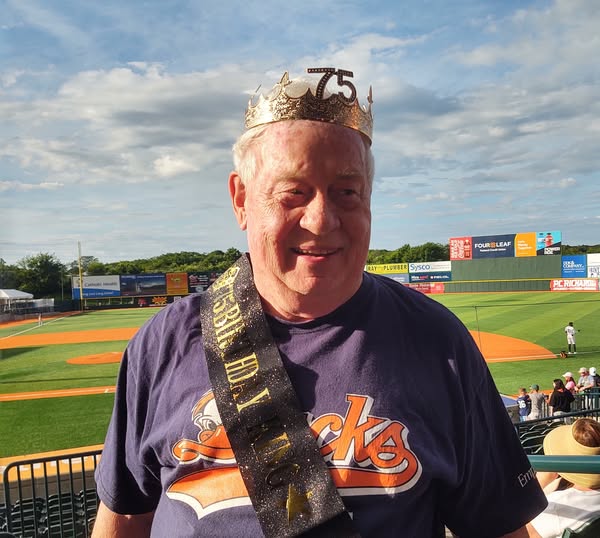
When Brother X—known in legal circles as Donald—turned 75, he didn’t ask for much: just a day at the ballpark with 50 people who mattered. For a man whose influence spreads through family trees, Lions Club meetings, and neighborhood barbecue debates, this was no ordinary birthday. This was a coronation.
But before the crown and sash came the journey. Since his family frowns on him taking long road trips alone, Donald and his daughter Beth arrived in Lancaster Thursday night so they could pick me up Friday morning and avoid a round-trip marathon in one day. Beth, a cop, rode up front. I climbed into the back—on the right side. I stand facing the road and back into the seat. Then I push myself as far into the vehicle as possible with my good right leg. I hit an obstruction, an arm rest, so I raised it and pushed again. Success, so, I swiveled to adjust myself into the seat and I was ready to go.
“Where’s that coffee you promised?” I asked.
“In the armrest,” he said.
Oops. I pulled the arm rest down, only to discover that half the cup had already christened the upholstery. Auspicious beginnings as Jack Nicholson said in the movie Five Easy Pieces. Brother X cleaned up the mess, and I laughed and ate the bacon, egg, and cheese sandwich, which he also provided. We took the slow but scenic route out of town and had clear sailing until we got to New York—specifically, the Belt Parkway, which transformed into a parking lot with signage.
Beth, ever the navigator, detoured us through Flatlands, where she had worked when she first joined the N.Y.P.D. Traffic still crawled, but at least it was scenic. We finally reached Seaford just shy of 3 p.m.
With our concert plans for the evening canceled, Donald asked me what I wanted to do. I’d never seen Ted Lasso but had heard enough to know it might be the perfect show to binge-watch in whiskey-soaked solidarity. Donald had already seen all three seasons—but gladly rewatched them with me.
We binged season one. We cracked open the Jack Daniels he bought for my birthday in August. It was classic Paulson bonding.
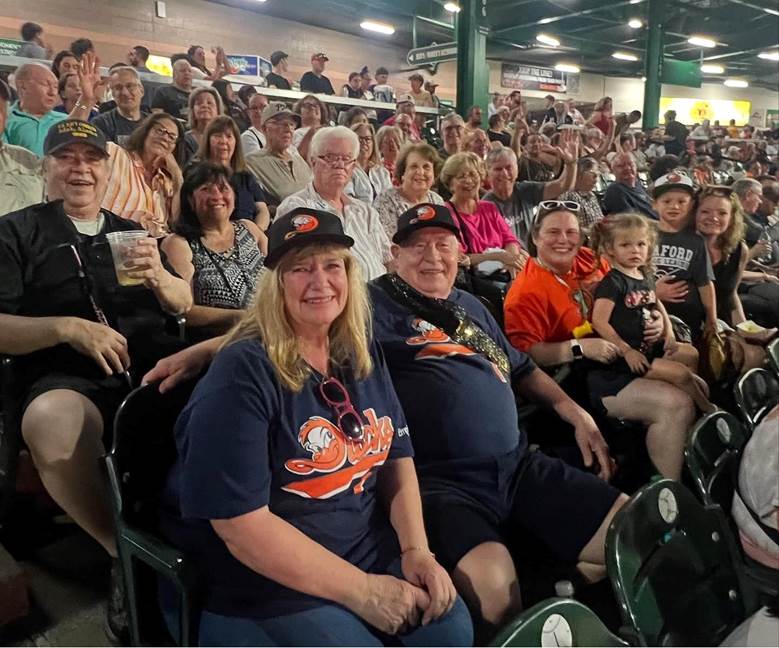
Saturday was Game Day. Brother X removed the baby seat from the car, added his late wife’s rollator for me, and Kathleen (his girlfriend, who he met in Iceland in January) and Beth joined us for the ride to Commack. That ballpark is special to him because one year when he was named one of the six Seaford Patriots, for his work in the community, one of the perks was throwing out the first ball at the Commack stadium. At the ballpark, we joined 47 of Donald’s friends and family. (One missed due to illness.) They handed him a sash: “Happy 75th Birthday” and crowned him with a metal tiara marked with a bold 75. When it looked like a thunderstorm might pass by, I encouraged him to take off the metal crown he was wearing and hold it up high in the air. Sarcasm is also part of the classic Paulson bonding.
Many of his friends were also turning 75, so Donald paid for their names to appear on the jumbotron after the second inning. It was festive, chaotic, and beautiful—even if the Ducks lost 7–2 to the Dirty Birds.
For Sunday, Donald had arranged a memorial mass for our late brother Kevin, a gay police captain and columnist for the San Francisco Chronicle, who would have been celebrating his 67th birthday that day. Kevin wrote eloquently about his life with partner Brian and their adopted sons—Zane, who danced too close to the law, and Aidan, a shy, quiet soul now making his way through college. Kevin once said he took inspiration from former Chronicle columnist Mark Twain, who warned, “Never let the truth get in the way of a good story.” I think Kevin held a higher rank than Captain, but I, too, never let the truth get in the way of a good story.
As an atheist, I was lovingly excused from church. Instead, I slept in and later, X and I taught Kathleen how to play pinochle. After she took all our money, we went back to our Ted Lasso marathon.
Kathleen bought me two big bottles of Moscato Sangria. On Monday, we drank wine, ate Chinese takeout, played more cards, and finished season two of Lasso. It was comforting, light, and full of laughter.
On Tuesday, Don and I visited my best friend John, now undergoing chemotherapy. His body had shrunk, but his wit hadn’t. We joked, talked Yankees, and filled his “recovery room” with laughter. It was the kind of visit that sticks to your ribs, even more than the sauerbraten we ate later at Das Bierstube, which I call “Das Digs” combining the old and new names of the bar/restaurant.
My mother’s sauerbraten was the stuff of legend, even outshining what I once tasted in Germany. So we go out for sauerbraten not for flavor, but for ritual: to remember her, to compare notes, and to declare—again and again—that no chef measures up.
That evening, we had hibachi at D.J.’s house. I was too full to eat but not too full to drink. We sipped beers while Cooper and Chloe ran wild in the backyard, turning it into a small summer paradise.
Back in Seaford, Donald and Kathleen went to bed, but I stayed up until 4 a.m. finishing Ted Lasso. I needed that final episode. I needed to feel what Coach Lasso felt when the journalist handed him the book: The Lasso Way.
But Ted had it right. He renamed it The Richmond Way. Because it wasn’t about him. It was about all of them.
We left Seaford at 10 a.m. and arrived in Lancaster by 2. Kathleen treated us to cheesesteaks and a hamburger from the shop across from my house. Then she and Donald went to their hotel for a swim and some sleep before heading back to New York.
The Seaford Way is not about Donald alone. It’s about Beth, with her grit and grace. It’s about Kathleen, who learns card games and brings sangria and cheesesteaks. It’s about Kevin, who kept stories alive, even beyond truth. It’s about John and DJ, Stacy and Cooper, Chloe and sauerbraten—and yes, it’s about me, too.
But mostly, it’s about the people who show up. It’s about how Coach Lasso said goodbye—not with ego, but with love.
For my Dad’s Birthday this year, I would like to retell the story of the last road trip I went on with my father. On Father’s Day, I told the tale of our trip to his Army reunion in Indianapolis. This is the story about our trip to his Army reunion in Washington, D.C. which took place in October of 2006. It was reprinted on the Third Armored Division’s website, along with all the poems he wrote during WW II.
This year, for the second year in a row, I went with my dad to his Spearhead 3rd Armored Division, Army Reunion. Last year we went to Indianapolis and had a lighthearted romp in the nation’s heartland. This year the reunion was held in the nation’s capital. So Dad and I spent the last five days together in Washington, D.C. This year it was murder.
Fortunately, the murder was only on the stage in Shear Madness, a delightful murder mystery play we attended on Saturday night at the Kennedy Center for the Performing Arts. The audience, contrary to what I expected, consisted not of Washington elite, but of the group of WW II Vets I was with, and two large groups of high-school students. The students thoroughly enjoyed the interactive portion of the show where they helped “solve” the murder, and the seniors thoroughly enjoyed watching the youngsters have fun. Everyone got a kick out of how the actors worked the 3rd Armored Division and both High School names into the plot. I liked the rockin’ soundtrack, so I’m sure my father didn’t. At least now, he’s no longer yelling for the damn music to be turned down, like he used to when I was a teenager. Nowadays, he’s hi-tech. With the flick of one switch, he can turn both his hearing aids off.
That morning, before the show, we had taken the Monument Tour. Our guide was Kenny. The first stop on the tour was the Marine Memorial, with that famous sculpture of the Servicemen raising the flag on Iwo Jima. The monument is inscribed with the years and innumerable battles the marines have fought all over the world since 1775. This list went on and on and on. Back on the bus, I turned to my father and said, “I knew that the Navy and the Marines didn’t get along, but it looks like Marines don’t get along with anyone.”
We spent the whole week the same way, sharing memories at the memorials and trading barbs on the bus.
The next stop was the Vietnam Memorial. Upon arrival, I announced with pride to the bus of grisly veterans that “This was my war – the one I fought to get out of.”
Thousands of names are carved in the marble chronologically representing each one of the killed and M.I.A. from the Vietnam conflict. The morning was rainy and bleak, and the memorial looked bleak, too. To me, it looked like the headstone for a mass grave. It was kind of creepy. I noticed that John Anderson was the first name scratched into the stone. I was going to go to the far end of the monument to see who the last name was when I thought of the poem by John Donne. “Ask not for whom the bell tolls. It tolls for thee.” Then I noticed a woman with a little slip of paper making one of those pencil shading pictures of the name etched in stone below where she had placed the paper. The two volunteers who had helped her find the section of the monument where the name she sought was carved, stood quietly behind her as she made the shading. When she was finished she got up and hugged both of them. As the woman walked away, there were tears in her eyes, but she was smiling too, and the same thing was going on with the two volunteers. Even though this had to be at least the thousandth time they had helped somebody find a name on the wall, they were still touched by every one of them. I was touched, too.
There were no assigned seats on any of the tour buses, but people invariably would return to the same exact seat after every memorial stop. On the Arlington Cemetery tour I boarded very late. The tour began just after breakfast one morning and my father figured I had probably gone back to bed. He knows I’m not fond of cemeteries, so he got on the bus by himself. By the time I showed up, somebody was already sitting next to my father, so I took an empty seat in the back. After the first stop on the tour, I switched to the seat next to my father. This shift was noticed by one of the ladies, who, just for conversation sake, asked me why I decided to switch seats.”
“Rosa Parks says I don’t have to sit in the back of the bus, anymore” I joked, knowing from previous experience that my father would use the opportunity to talk about the two African-American boys my brother Kevin adopted.
“That’s right,” my Dad said as he proudly pulled out his wallet to show her pictures of his two “colored” grandchildren. “We be black now, so we can sit anyplace on the bus that we want.”
“They’re beautiful children,” the lady said smiling approvingly at the pictures, “and I don’t see any color at all.”
“I know how it is,” Dad replied. “My eyes aren’t so good anymore, either.”
I’m not sure if she knew he was joking.
Shelley the Guide on that tour was super. She was more than super. She was supercalifragilisticexpialidocious. Many Washington Tour Guides resemble Mary Poppins with their brightly colored umbrellas leading a pack of tourists around. Whenever it was time to get back on the tour bus, Shelley and her big yellow umbrella would suddenly appear. Washington Tour-Group guides must have to work extra hard to keep track of everybody on rainy days, when everyone has an umbrella.
Our drivers on a couple of the bus tours we took were two black guys named Roscoe and Rodney. I’m not making that up. It was straight out of central casting. I kept asking them to please drive by Dupont Circle, which is mentioned in one of my favorite movies, The American President. They did their best to ignore me.
Shelley couldn’t ignore us though. It was her job to work the crowd. One of the things Shelley liked to do was test our knowledge of Washington, D.C. trivia What my dad and I liked to do was test her patience.
“On your right is The White House. Can anyone tell me who is the only U.S. President who never lived there?”
“Al Gore,” I shouted.
We were like Charlie Weaver and Paul Lynd on the old Hollywood Squares TV Show. Even if we knew the correct answer to one of Shelley’s trivia questions, we wouldn’t answer until we could first come up with a joke answer.
One part of the FDR memorial was a just a pile of great big rocks. I asked Shelley if that was the Marriage Memorial.
“Washington D.C.,” Shelley said, “was built on a swamp and occasionally we have had some flooding. Does anyone know the elevation of Washington D.C.?”
“Lower than pond scum.”
On the right is the Pentagon. Donald Rumsfeld has his office here.
“Stop the bus, and give me a rock,” my Dad yelled out.
On Monday, our tour stopped for lunch at the Pentagon Fashion Center. How’s that for an oxymoron? Pentagon Fashion. Even more interesting was one of the t-shirts they were selling in this mall, just a stone’s throw from the Pentagon. It said:
Tank of Gas: $100
Prescription Refill: $500
Iraq War: $300,000,000,000
New President in 2008: Priceless.
I also found it amusing that each famous place on the tour seemed linked to an equally infamous one.
“On the left is the Jefferson Memorial. On the right is the Tidal Basin where in the 1970’s House power-broker Wilbur Mills was caught cavorting with Fanne Foxe, the Argentine Firecracker.”
There are memorials everywhere you go. While we were there, construction was just finishing up on The Air Force Memorial, which we could see clearly from our hotel window. There must have been at least 50 different Memorials in a town that’s notorious for people who can never, ever, remember anything, especially if they’re under oath.
Many things in Washington are etched in stone, and I don’t mean that figuratively. Unlike New York, where the words of the prophets are written on subway walls, in Washington they’re etched in stone all over the place. The most brilliant statements made by some of the greatest leaders the country ever had are carved into the walls, where you can not only see them but touch them. It’s just a shame that only the tourists are reading them.
On one tour, I learned that Smithson was an English metallurgist who made a fortune on zinc oxide or something like that. He wanted a title and a castle, but because he was illegitimate he wasn’t able to marry a woman of title in England. To spite them, he gave his entire fortune to America, which was how the Smithsonian Museum began. The architect designed one of the Smithsonian buildings to look like a castle in his honor.
Extraordinary coincidence #1. On the same weekend, in the same hotel, having their reunion was the airborne squadron that my father claims accidentally strafed the 3rd Armored Division when they broke through into Germany, because they didn’t think there could possibly be any Americans in Germany, yet. The Army denies that this ever happened. I believe my father.
At the men’s luncheon, we watched a German version of the 3rd Armored Division’s Battle of Cologne. I couldn’t help but think that there probably wasn’t an English version of the film because there simply wasn’t enough profit in the project for an American company to make the movie.
On Saturday, the tour stopped at Union Station for lunch. I was in the Mall and looking all around., because I couldn’t believe that there actually was a train station in America that didn’t have a McDonald’s, Burger King, Wendy’s, or KFC. There must be a secret war on Transfats going on in Washington.
“Did you lose something?” an inquisitive cop said to me, as he saw my eyes gazing around the mall.
“Well, my dad wandered off!” I told him.
“What’s he like?” the cop asked.
“Bourbon, playing cards, and dancing,” I said, “but don’t help me look for him; I’m actually hiding.”
Whenever we asked Dad the question, “Where should I sit?” my father always gave us the same riddle answer, “Sit where your mother sat when she got married.” It took us kids years to figure out that he just meant, sit on your ass; I don’t care where. When we went up the stairs at the Lincoln Memorial, he told me that when she was young, my mother had actually climbed up the statue of Lincoln in the chair and sat on his lap. I couldn’t help but think, “Gosh, my mother was actually young once, too. Wow!’ Seeing how high up Lincoln’s chair was, I also realized that to sit where my mother sat, she sometimes needed a boost. Don’t we all?
I offered to give my dad a boost if he wanted to “sit where my mother sat,” but he declined my generous offer.
At the FDR Memorial, Dad told me that my mother had once written to Eleanor Roosevelt inviting the First Lady to her graduation and Mrs. Roosevelt actually showed up.
My father and I really enjoyed one another’s company this past week, but I had an ace up my sleeve. Any time Dad busted my horns I said, “Be good, or we’re sending Kevin and his kids with you next year.”
At the World War II Memorial, the highlight of the tour for mostly everyone on the bus, the names of all the States of the Union are carved into sections of the stone. People get their pictures taken by the names of their state. My father heckled the people from the tiny states, whenever they would stand up to have their picture taken. “I didn’t know that they had any people in New Hampshire”
When our tour bus got to Arlington National Cemetery, we hopped on a trolley car that took us to all the high points of interest. Our tour guide Shelley had to take a back seat to an official Arlington Cemetery Tour Guide, so it was very informative, but he didn’t know the particulars about the group he was leading. I noticed that we went right past the 3rd Armored section of the Cemetery without a word mentioned about it.
At Arlington we went to the grave of John Kennedy, which is at the bottom of a hill. Robert E. Lee’s House was at the top of that hill, and, according to our guide, the view was spectacular. He said that when John Kennedy was standing on that hill, he had remarked to Jacqueline that he could spend eternity there. That’s why, after his death, the family had him buried there. Our tour guide assured us that he would take us up to the Lee House later in the tour. (But we drove by the back of the house, so we didn’t see any of the amazing view that Kennedy loved.)
I did pick up the best bargain of the tour at Arlington, though. There was a guy in the parking lot selling 10 photo postcards for a buck. I wondered how long a prison term you would get for sending the Arlington Cemetery postcard to President Bush or Dick Cheney and writing “Wish you were here” on it. I also wondered whose name I would forge on the postcard if I ever did that.
Shelley pointed out that the two Senate Office Buildings were officially named recently in an effort to get people to stop referring to them as the Old SOB and the New SOB.
“Is everyone ready to get back on the bus?” Shelley said.
“Hold up a minute, I’ve got to pay a visit to the Wang Memorial.”
Vic Damon, the 3rd Armored Division’s Webmaster, was one of the guest speakers at the final dinner. As a computer geek, he did not appear to be comfortable in the limelight of public speaking, but he sure knew a ton of facts about the 3rd Armored Division. Not only had he read the thousands of tales submitted to the website by hundreds of people, but he had personally researched and visited some of the places of interest. He even had pictures of the Connecticut house where the Division’s leader General Rose was born, and an aerial view of the spot where the beloved general was ambushed by the Germans and murdered. After years of posting all these stories on the Internet and visiting the archives, Vic couldn’t stop thinking of interesting stories related to the main story he was trying to tell. “One last thing, before I get back to my last thing” was an oft repeated line. I guarantee that if you go to the website, you will be fascinated by the thousands of articles, photos, and first-hand accounts of the war. (www.3AD.com)
General Rose’s great great nephew was there to speak about his great great uncle, and wound up very diplomatically giving the praise to the great great troops General Rose had to lead. That got a round of applause and numerous campaign pledges if the young man should ever want to run for public office.
I don’t want to mislead you. This may be a reunion for WW II veterans, but there are a lot of younger people there, too. Most of them are the sons and daughters who either join their parent or who come in honor of a deceased parent. The youngest person at this year’s convention was Jordan, the granddaughter of the 2006 Association President, Bill Heinz. Every one of us wished that we had her energy. She danced. She sang with the band. She led the group twice in the Pledge of Allegiance to the Flag. The little girl had so much energy, she made the Eveready Bunny look like a narcoleptic.
One last thing, before I get to my last thing.
There was another incident one night on the tour bus that I was going to omit from this story, but I think that you’re bound to hear it elsewhere, anyway so I might as well tell it here first.
On our way back from the Kennedy Center, an elderly woman went up to the driver and said, “I’ve just been molested!”
The driver felt that she must have fallen asleep and had a dream. So he told her to go back to her seat, and sit down.
A short time later, another old woman claimed that she was just molested. The driver knew he had a bus load of old whacko’s, but doubted if anyone could possibly be molesting these two old ladies?
About 10 minutes later, a third old lady went up and said that she too had been molested.
The bus driver decided that he’d had enough, and pulled into the first rest area. When he turned the lights on and stood up, there was an old man on his hands and knees crawling in the aisles.
“Hey pops, what are you doing down there? ” the bus driver demanded.
“I lost my toupee,” he said. “I thought I found it three different times, but every time I tried to grab it, it ran away!”
Another last thing before I get to my last thing. This one is serious.
After visiting the front lines in WW I, FDR said, “I have seen war. I have seen war on land and sea. I have seen blood running from the wounded. I have seen men coughing out their gassed lungs. I have seen the dead in the mud. I have seen cities destroyed. I have seen 200 limping, exhausted men come out of line – the survivors of a regiment of 1,000 that went forward 48 hours before. I have seen children starving. I have seen the agony of mothers and wives. I hate war.”
And yet he wound up leading the country through World War II.
One generation fights a war so that their children will not have to go to war, but war still does not skip a generation. The men and women in World War II were there because the “War to end all wars,” which their fathers fought, didn’t end all wars. Neither did their war end war. In the 60 years since World War II ended, we’ve had Korea, the Cold War, Vietnam, Persian Gulf 1 & 2, and Granada, to name a few. War gets passed along from generation to generation similar to child abuse. It’s a vicious cycle. Abuse breeds abuse. War breeds war.
I’d like to see one last memorial in Washington, D.C., The War Itself Memorial, a stone to commemorate the death of war. A monument to the day the world learned to live in peace. Make it out of wood, and we, the living, could all go carve our own names on it. Then, the sacrifices made by all the people in previous wars, will finally stop being in vain.
While I gazed on the rows and rows of Graves in Arlington Cemetery. I couldn’t help but think of these words by Bob Dylan:
How many times must a man look up Before he can see the sky? Yes, ‘n’ how many ears must one man have Before he can hear people cry? Yes, ‘n’ how many deaths will it take till he knows That too many people have died? The answer, my friend, is blowin’ in the wind, The answer is blowin’ in the wind.
By virtue of the power of the 3AD Webmaster, and by outliving so many of the other guys from World War II, my father has become the poet laureate of the 3rd Armored Division. The poems he wrote about his army career were collected into a book called Dogface Doggerel. Many of those poems are freely available for all to read on the aforementioned http://www.3AD.com website. After the past weekend, Dad too was nudged by the muse and he decided to put his feelings down in a poem. In extraordinary coincidence #2, it turns out that my father and I did something this week that we tried desperately not to do in the past. We agreed on something. He, too, felt that there should be another memorial in our nation’s capital. He actually felt we needed two more. Here is the poem he wrote to explain why.
WE NEED A NEW MEMORIAL
By Harold A. “HAP” Paulson
I just returned from our reunion, In Washington, D.C. It’s a city full of memorials, To honor folks like you and me.
Tribute is paid to the Air Force, The Seabees and the Marines. Vets from the war in Korea, Vietnam and other scenes.
We honor the women who went to war, And those who stayed behind, And the National cemetery at Arlington, Is a reminder for all mankind.
Please don’t think we have enough now, I’d like to add two more, To the paraplegics, the blind, the lame, All those invalids from the war.
I’d place one on the White House lawn, And one on Capitol Hill, A gruesome reminder to politicos Of those men still paying the bill.
It would have a wheelchair and crutches, A cane for those who are blind, A hospital bed from a burn unit And orthopedics of every kind.
I’d place one so that the PRESIDENT, When he arose each morn, Would get a reminder from it, Of the load these men have borne.
And the one up at the Capitol, As an inscription would have this plea, “The next time you declare war, Enlist yourselves, but don’t send me.”
—————————–
One more last thing, before I get to my last thing.
Studies have shown that more people die in the months just after their birthday than in the months just prior to their birthday. The hypothesis is that looking forward to something helps you keep living. As we get older, and birthdays are less anticipated, maybe we might live longer if we are looking forward to some other things, such as Reunions or Anniversaries (Well, maybe not in all cases, but in some). My dad was the only member of his 703rd Tank Destroyer Battalion healthy and young enough to make it to the Spearhead reunion, and I know it is because every year he looks forward to spending a few pleasant days with the gang who went slogging through hell with him. Now I have something great to look forward to, also, next year’s reunion in Louisville, Kentucky. I’m hoping to bring back some souvenirs from Fort Knox.
Peace and Love, and all of the above, Earl
P.S. We never did make it to another reunion, as Dad wasn’t healthy enough to make the trip, but he still managed to bring good times to the folks in the senior-citizen village in Florida where he spent his final years. Happy Birthday, Dad.
MY DAD AT REUNION TIME – A story I wrote for the 3rd Armored Division’s website.
By Earl Paulson
3AD.com Web Editor’s Note: This is a part-humorous, part-serious “must read” for anyone who knows Hap Paulson personally or knows him through his Army-related poetry. The author is the oldest son of Harold “Hap” Paulson (703rd TD Bn & 3AD Association Poet Laureate). In this true and often side-splitting story, Earl writes of events surrounding the trip he made with his father to the Association Reunion in July, 2005, in Indianapolis. This work first appeared in Earl’s personal newsletter called “Earl’s Wearld” and then in the Association Newsletter in Sept., 2005.
I’m back from my Dad’s 3rd Armored Division Army reunion. What a week! I hadn’t spent five straight days with my father since I was a teenager at Boy Scout Camp. It was quite an experience. I’m amazed that my mother lived with the man for more than fifty years and never once tried to kill him (or herself). My Dad has both a photographic memory for old jokes, and the uncanny ability to spot them in everyday life. He also has the gift of gab, though I’m not really sure that it would rightly be called a gift.
The night before we left for Indianapolis, I stayed with him at his summer house in Yaphank, NY. Reveille was at oh-three-thirty. That’s 3:30 A.M. to you civilians. My 86-year-old father, who can no longer read without his glasses and a magnifying glass, but still has his Florida driver’s license, drove us to Islip Airport in the middle of the night. Surprisingly, I wasn’t afraid, even though it was pitch black and pouring rain, because I couldn’t see either.
Somehow, we managed to get to the practically vacant airport long-term parking lot around 4:30 A.M. We sloshed the couple hundred feet to the terminal to find that they were only kidding us about having to be at the airport two hours before our 7 A.M. flight. The counter wasn’t even open yet — nor was the coffee shop.
My father is a very religious man. While we were waiting in the airline terminal, he took out his rosary beads to pray. All the security guards saw this. When we got to the security check we were both strip-searched before we could get on the plane. Despite this, the flight to Philadelphia did, still, leave on time and with us on board. The connecting flight in Philadelphia, though, was delayed, because of bad weather the day before. We had a three-hour layover in Philly. We took a shuttle bus from Terminal F, where we had landed, to Terminal C, where the connecting flight to Indianapolis would depart. After that, we still had two and a half hours to kill.
My dad loves pancakes, so we decided to find a MacDonald’s and have breakfast. Surely, there had to be a MacDonald’s in one of the food courts. There was. However, it was in terminal A! The original reason for me to take this trip was because my father’s heart condition made him feel uncomfortable about traveling alone. My Uncle Leon, who went with him to the reunion held in Europe last year, was going to go with him again this year, but he had heart problems of his own and was unable to make it this year.
So, aware of my father’s heart problem, but also aware that we had a lot of time to kill, I asked my Dad if he was up for a leisurely stroll to the McDonald’s in Terminal A. He told me that he goes to a gym regularly and does 20 minutes on the treadmill and 20 minutes on the stationary bike every day, so, he could handle it. It took us almost an hour, because it was so far away, but we made it there no problem. On the way back though, Dad tried to stop all of the golf carts taking handicapped people from one gate to another. He faked three heart attacks trying to get them to stop. Nobody stopped. They just rang their little bicycle-type bells at him and sped by.
When we eventually got back to terminal C, we still had plenty of time before our flight. So, he wandered about our waiting room asking everyone over 60 if they were going to Indianapolis for the 3rd Armored Division Reunion. Anybody who wasn’t going to the reunion was regaled with a brief history of the famed “Spearhead” Division. Finally, though, he found someone who was taking his grandson to the reunion. We all agree to share a cab from the airport. Well, the reunion committee had mentioned something in their newsletter about an arrangement being made with a local cab company for a special rate for those people attending the reunion. So, when we got to the terminal in Indianapolis, my father asked the girl at the limousine desk where we could find that cab service. “Right here,” she said without missing a beat, and I knew this girl was a natural for sales. The next thing I knew, the four of us are riding in a limousine capable of holding an entire Army platoon. I felt like a rock star.
We drove past the downtown section of Indianapolis, and then just kept going and going. The hotel seemed to be closer to Chicago than Indianapolis. Finally, we got to the hotel, and the old soldiers who were already there saw the size of the stretch limo and thought a General must be arriving. The Sheraton hotel we stayed in had two buildings. After checking in, we wandered up and down the 6th floor for an hour looking for room 643 before we found out it was in the other building. Hup-two-three-four. On we marched. We registered for all the events Dad wanted to attend, and then found ourselves with time on our hands before the first event. We had already done enough walking for the day, so we decided to visit the hotel pool and relax. We changed into our bathing suits and headed for the 3rd floor pool. When we got there, we found that it was closed for the day for routine maintenance. We got back on the elevator which was now full of Dad’s old Army buddies. “How’s the pool, Hap?” (That’s what my Dad’s friends call him. His initials are H.A.P., Harold A. Paulson.) “We got thrown out,” he tells everyone on the elevator, as he sees an opening to tell a joke. “The lifeguard caught my son peeing in the pool and threw us both out.” My son argued that it wasn’t fair because everyone occasionally pees in a pool, but the lifeguard said, “That may be true, but nobody else does it from the diving board.” Half of his buddies laughed at the joke. The other half gave me a strange look. Fortunately, we had reached our floor by then.
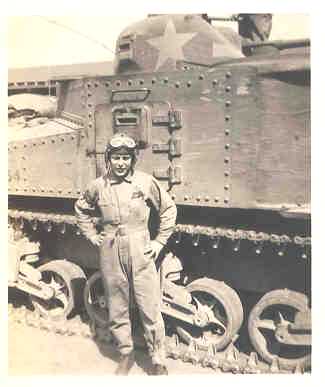
The week was filled with enjoyable social events, but there were also many serious moments, such as the memorial service for the many “Spearheaders” who died during World War II. A list of their names was posted, and I didn’t have time to count all of them, but I counted over 700 names in just one Infantry Regiment of the 3rd Armored Division. My father’s unit, the 703rd Tank Destroyers, had 71 guys killed in action. During the war, my father was lieutenant-in-charge of a platoon of 32 men. Those 32 guys were collectively awarded a total of 64 Purple Hearts, but only one died. He was Earl R. McCleary, and I was named after him, even though he was a poor illiterate sharecropper from Virginia who had absolutely nothing in common with my father other than that they had gone through Hell together. When I listened to the stories these guys told me during the week, I thought of that Billy Ray Cyrus song, “All Gave Some; Some Gave All.”
That’s enough of the serious moments. I have a lot more bloopers to share. Being guests of the hotel gave us privileges to use Bally’s Fitness Center next door. I decided to accompany my dad on his daily trips to the gym to do the cardiovascular routine prescribed by his doctor. Since I was there anyway, I figured I’d take advantage of the machines too, especially after I saw my reflection in the full-length mirrors on every wall. I knew from previous experience years ago how to use the Nautilus equipment, varying the weights to amounts that I could do without killing myself. I didn’t want to push myself too hard, even if I did need a good workout. After all, I was there to keep an eye on my dad’s health, not create problems with my own. I had never been on a treadmill before, but I figured I’d give it a try since walking is one thing I know I’m naturally good at.
So, while Dad did his stretching exercises, I headed for the fancy machine. It was computer operated, but there was more to it than just turning it on. I had to use a keyboard to enter all sorts of data. The machine calculated my target rate based upon factors such as my weight and age. My target rate was 106 heartbeats per minute. I pushed the button for an aerobic workout and started to walk. There were sensors in the machine that automatically monitor the heart rate, but you have to be wearing some kind of belt. I wasn’t wearing one of those devices, so the machine just assumed, as a starting point, a normal pulse around 60 or so and the conveyor belt started. When the machine did not detect any increase in my pulse rate, after so many seconds, it increased speed and inclination to help me reach my target heart rate. So, every testing cycle, the machine would continue to measure my pulse rate at the same 60 beats per minute and determine that I was not yet expending enough energy to produce an effective workout and automatically increased both speed and elevation. Before long I was on a machine going 90 degrees straight uphill at the speed of sound – that sound being my screaming as I did my best imitation of a Vonage “stupid things people do” commercial.
On Saturday my father and I headed for a post-workout dip in the pool, only to find that the pool was once again closed. This time some kid pooped in the pool. We got back on the elevator and another group of Army buddies suddenly became the audience my father needed for the chance to tell the same exact diving board joke another time. I pictured my Mom in Heaven rolling her eyes, shaking her head, and saying “That’s Harold.”
Since Dad and I now had time on our hands, we changed out of our bathing attire and went to the Spearhead hospitality room for a beer. Sure enough, as soon as we got there, Dad told all the guys who asked him why he wasn’t in the pool, that we had gotten thrown out because I took a dump from the diving board. (Author’s note. The pool was only 5 feet deep at the deepest end and didn’t even have a diving board.)
On our way home from the reunion, Dad was at the flight gate again praying his rosary. Now, London had just been hit by four terrorist attacks the day before. Everyone in the waiting room who was watching him was getting nervous. So, he was strip-searched again. This time they let me go, but I noticed that they kept an eye on me. Boarding the flight home on the Philadelphia-to-Islip leg, my father and I were sitting in the aisle across from one another. A pretty coed is sitting next to me. The seat next to my father is vacant. Then just before takeoff time a middle-aged woman comes up the aisle with a huge potted plant. Naturally, she has the window seat next to my father. Instantly, he starts making conversation with her. I turned to him and said, “I did what I could to make sure you stayed alive the last five days, but if you tell this lady I pooped in the hotel pool, I’m going to strangle you right here on this plane.




 earlthepearl137