Myths

Educated people don’t believe in unicorns. Or mermaids. Or Atlantis, Bigfoot, or the Fountain of Youth. These are dismissed as charming myths—cultural artifacts with no empirical backing. And rightly so. We’ve combed the forests, dredged the lakes, and carbon-dated the ruins. No horned horses. No fish-women. No golden cities.

But God? That’s different.

Despite the same lack of physical evidence, belief in God is not only accepted—it’s revered. Taught in schools, sworn on in courtrooms, and invoked in campaign speeches. The same minds that scoff at fairy tales will defend divine presence with philosophical rigor and moral urgency.

This isn’t a jab at faith—it’s a spotlight on the intellectual gymnastics required to hold both positions. The educated skeptic who demands peer-reviewed proof for mythical beasts will often grant God a pass. “It’s about faith,” they say. “Transcendence. Meaning.”

But why does God get the exemption? Why not the unicorn, who at least has the decency to sparkle?

Maybe it’s not about evidence at all. Maybe it’s about utility. God offers moral scaffolding, community, and cosmic comfort. Unicorns offer glitter and horn-based combat. One gets a cathedral; the other gets a Lisa Frank folder.

So, we believe what serves us. Not what’s proven. And maybe that’s the real myth: that educated people believe only what’s true.

This isn’t a call to abandon belief. It’s a call to examine it. To ask why some unproven ideas are cherished while others are ridiculed. To recognize that even the most rational minds are shaped by culture, emotion, and need.

And if we’re going to believe in things unseen, maybe we should give the unicorn a second chance. At least she never started a war.

Peace & Love, and all of the above,

Earl

Sandwiches and Santa Claus

WordPress sent me one of those algorithmic love notes: “You might like this blog as much as they liked yours.” It’s their way of nudging bloggers into polite reciprocity. When I first started my blog, 100% of my readers were close personal friends.  Now, 90% of subscribers are other WordPress bloggers.  She liked mine, so I clicked her link.

Her site was called _______IsAChristian. I won’t use her real name—let’s just say it was unmistakably evangelical. Now, I’ve been an atheist for twenty years, and an agnostic for twenty before that. So I approached with caution. But etiquette is etiquette. She liked my blog. I owed her a visit.

Her post was a long, winding story about her church group making sandwiches for people on the street. The kind of tale where the sandwiches are almost incidental. The real star was God—God in the bread, God in the mustard, God in the sidewalk. I read about two-thirds of it. That’s more than I give most stories.

Somewhere along the way, I left a comment. I said I wouldn’t try to debate her religion the same way I wouldn’t tell a child there’s no Santa Claus. It was a simile. It was also a little snide. But it was honest. I wasn’t trying to be cruel—I was trying to explain why I wouldn’t debate her beliefs. I figured she’d appreciate the boundary.

I followed up with something more generous: “As an atheist, I wasn’t moved by the religious framing, but I was moved by your group’s compassion for the hungry.” I meant it. The sandwiches mattered. The kindness mattered.

She replied: “You don’t love Jesus as much as I do.” And then more sermon. Less sandwich.

I commented one last time: “Bye.” And unsubscribed.

Then came the final message. A digital benediction wrapped in barbed wire:

“It was pleasure meeting, but I would be so blessed if you deleted me as a subscriber, so I don’t have to hear your negative comments on my posts because I don’t care about you, bye.”

My first reaction, of course, was “F*** you,” but I’ve learned to count to 10 when I’m mad.  My second reaction came after 2 or 3 reps of Seated Marching exercises. Ten counts on each leg. My final reply was simply “Done and Done. Bye.”

I’m telling this story from my point of view, of course. I imagine hers would be very different. Maybe she saw me as the Grinch who stole her comment section. Maybe she felt invaded. Maybe she just didn’t like the Santa Claus line.

But here’s the thing: I saw kindness in her actions. I saw people feeding the hungry. I just didn’t see the need to wrap it in theology. And maybe that’s the real divide—not belief, but packaging.

Sandwiches and Santa Claus. One nourishes the body. The other comforts the soul. And sometimes, both come with a side of unsubscribe.

Peace & Love, and all of the above,

Earl

Roe, Roe, Roe – and What’s Next

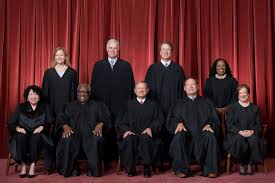
On January 22, 1973, the Supreme Court issued its landmark 7–2 decision in Roe v. Wade, protecting a woman’s constitutional right to choose.

The Dobbs v. Jackson Women’s Health Organization decision, made by the US Supreme Court on June 24, 2022, overturned Roe v. Wade and Planned Parenthood v. Casey, and removed the constitutional right to abortion in the United States. The decision gave states the power to regulate abortion access, and it has led to significant changes in abortion access across the country.

In the case of Engel v. Vitale, The Supreme Court ruled in 1962 that school-sponsored prayer in public schools is unconstitutional. 

I think that this will be the next thing that Evangelical Christians will use this Supreme Court to try to overturn.

Why?  It’s the same reason that Evangelical Christians overthrew Roe v Wade.  It’s because they’re losing, and they’re scared.

Losing?  They’re winning, you might say.  They got what they wanted, but I ask you, for how long?

We like to say that our country was founded by people who came here to promote religious freedom.  That’s just not true.  The country was founded by people who were not welcomed in Europe because their religious beliefs were not accepted by the ruling majority.  The Pilgrims came here because Europe didn’t want them.  They didn’t come here to promote all religious freedom.  They came here for the freedom to practice their religion.

Other religious groups came here for the same reason, for the freedom to practice their religion, not to promote religious freedom for everyone.  Some groups, like the Mormons, sprung up with new, unpopular religions, and they migrated to Utah, to have a place where they could freely practice a religion that the majority of the country thought was weird.

So, while many of the first settlers came here to be able to openly practice their religious beliefs, not all of their descendants continued to practice that religion.  Some converted to other religions, and some even stopped believing in God.  There are now dozens of different religions being practiced in the United States, including Christianity, Judaism, Islam, Buddhism, Hinduism, Sikhism, Jainism, Baha’i, Wicca, Native American religions, and many others.

And then came Communism, an ideology that included Atheism.  With that, came the Cold War.  Good God-fearing people of the U.S. vs the godless Russians.  We had to win the Cold War, because we had God on our side.  We were, therefore, morally superior.  To further our cause, the phrase “one nation under God” was added to the Pledge of Allegiance in the United States on June 14, 1954, when President Dwight D. Eisenhower signed a bill into law. 

On July 30, 1956, the 84th Congress passed a joint resolution “declaring ‘IN GOD WE TRUST’ the national motto of the United States.” The resolution passed both the House and the Senate unanimously and without debate. It replaced E pluribus unum, (Out of many, one.) which had existed before as a de facto official motto.  Take that you godless Ruskies.  We had God on our side, and we could prove it.  It said so right on our money.

Then The Union of Soviet Socialist Republics was formally dissolved as a sovereign state and subject of international law on 26 December 1991.  We didn’t need to invoke the alliance of an almighty God to defeat the Russians, anymore.  We won.

But like the song says, “Something’s lost when something’s gained.”  When we faced the Soviet Union only 2% of Americans called themselves Atheists.  Since the Soviet Union dissolved in 1991, however, those numbers are growing steadily.  Today, about 28% of U.S. adults are religiously unaffiliated, describing themselves as atheists, agnostics or “nothing in particular” when asked about their religion.  A growing percentage of Americans want freedom of religion to now also include freedom from religion.

This is why religious organizations are getting scared.  Church attendance is way down.  32% of Americans attended church weekly in 2000. Now, according to Gallup, only 20% of Americans attend church every week, while only 41% attend at least once a month.  The percentage of Americans who never or seldom attend religious services is 57%.  That translates to fewer people tossing their money into the collection plate, which is a major concern for all religions.  God may be all-powerful, but He still needs money to carry on His work.

So, the Religious Right is leading the charge to bring back religion, but deep down they know it is a losing battle.  While they still have the numbers, though, they are doing everything in their power to legislate religion.  In Louisiana, they recently passed a law to display the Ten Commandments in every public school.  They are threatening doctors who perform abortions with jail time, and they are screaming that all the school shootings are not caused by assault weapons, but by the assault on religion.  They don’t want to get rid of the guns. Their answer is to bring back mandatory prayers in school.

White groups are also worried about losing their grip on America.  With less than 61% of the population representing as White, they are afraid that soon they will be the minority.  They’ve already seen the country elect a mixed-race President.  So, they are trying to limit the number of non-whites who can enter this country and become citizens.  They want to limit immigration to only the “good countries,” meaning, of course, the white countries.

White Nationalists and Christian Fundamentalists are combining in a futile effort to bring back “the good old days” when only white men became President and God was on our side.  They won’t do anything  about assault weapons in the schools, but they will be down on their knees praying for the overturning of Engel v. Vitale, and a return to the “good old days.”

To quote Kamala Harris. “We’re not going back.”

Peace & Love, and all of the above,

Earl

I Believe

I’m currently working on a screenplay about our 15th President, James Buchanan. The setting shifts back and forth between the present and 1863. How do I get the audience to believe that they are going back and forth between the present and 1863? I can’t. But I don’t have to make them actually believe it. Audiences are conditioned to “suspend disbelief” in order to enjoy the show. If you tell, or somehow show them that it is the present, they will go with it. If you dress the actors in clothes from 1863, the audience will “play along” and accept that it is 1863.

In a wintry scene, their reasoning minds might know that a stagehand is sprinkling white confetti on the stage from above, but when they learn to suspend disbelief, the audience will enjoy the “snowfall.” In the theater, in movies, audios, or in reading, we need to be able to sometimes disengage our reasoning mind and engage our imagination in order to enjoy it. Basically, there is an unwritten covenant between authors and their audiences. You suspend your disbelief for a couple hours and I will give you a couple hours of entertainment.

tinkerbell

Did you clap your hands and say “I Believe” when Tinkerbell was dying?

Samuel Taylor Coleridge, who wrote the Rhyme of the Ancient Mariner, invented the term suspension of disbelief in 1817. He wanted you, sitting in your comfortable easy chair, to clearly imagine the anguish of the cursed mariner drifting far at sea “with water, water everywhere, but not a drop to drink.”

Wikipedia defines the term suspension of disbelief as a willingness to suspend one’s critical faculties and believe something surreal. It is the sacrifice of realism and logic for the sake of enjoyment.

Sometimes we need to use both our reasoning mind and our imagination to get the most effect from a story. If we are watching a murder mystery, we use our reasoning mind to gather the clues, but we must use our imagination to suspend disbelief that the “murdered” actor is not really dead, or that the famous detective is just an actor.

We can be thrilled watching a magician saw a woman in half, though our reasoning mind knows (or at least hopes) that the woman is not really cut in two. We know that she will be back for the next performance. We must suspend this disbelief, though, to be able to enjoy the magic and the illusion.

More than 60 years ago, I was an avid fan of comic books, especially the DC comics, which featured Superman, Aquaman, Batman, Green Arrow, and other superheroes. To enjoy a comic book, we need to suspend disbelief and accept the character’s amazing, and often quite unbelievable, skill set. We know that man can’t fly, but we accept that Superman can. We know that man can’t live underwater, but we accept that Aquaman can. We accept an unrealistic premise in order to enjoy the story.

Places of worship are theaters in a way. In them, we are also able to suspend our disbelief and fully enter another world. It takes conditioning and practice, though, for us to be comfortable enough to lower our reasoning and boost our imaginations. Not surprisingly, those raised by Christians can easily adjust to the theater of a church, but they are not conditioned to equally accept the different customs of a synagogue or a mosque. Those raised by Jews can adjust to the theater of a synagogue but find themselves unable to adjust equally to the different ways of a church or mosque. Those raised by Muslims can adjust to the theater of a mosque, but not much else.

A Muslim man can imagine that if he died killing Christians and Jews he would be rewarded in paradise with dozens of virgins. Christians, Jews, and Atheists all think that this is absolutely crazy. A Jew or Muslim might abstain from the delicious taste of pork, lobster, or shrimp, because of what he is told in his Bible, Torah, or Koran. Christians and Atheists find that a bit crazy, even though Catholics once believed they would go to Hell if they ate a hot dog on a Friday. Christians believe that the wafers and wine served in Communion are transformed (transubstantiated) into the body and blood of their Savior, Jesus Christ. Jews, Muslims, and Atheists think of this as crazy, and maybe just a bit cannibalistic. Scientist just disavow it. Wine has a certain percentage of alcohol, while most people’s blood (except mine, of course) has a lower level of alcohol. “Transubstantiated” wine retains all the alcohol content and properties of wine, not blood.

Mormons, Jehovah Witnesses, Christian Scientists, and Scientologists – they’re all bat shit crazy, according to everyone who is not themselves a Mormon, Jehovah Witness, Christian Scientist, or Scientologist.

Atheists believe that all the world’s religions are crazy, and, reciprocally, all the world’s religions believe that Atheists are delusional. Many people don’t even accept that anyone could honestly be an Atheist. “There are no atheists in foxholes,” they have decreed. The Atheists counter that everyone in a foxhole must, in fact, be an Atheist, because if you truly believed that an all-powerful supreme being, who loved you, held your life in His hands, you would defiantly stand in the open and just dare the enemy to waste their ammunition trying and kill you. Picture that scene in Dances with Wolves, when Kevin Costner’s character, dreadfully worried that his injured leg will soon be amputated, decides instead to ride his horse back and forth in front of the enemy lines, actually preferring that a bullet will kill him instead of a surgeon.

Dances with Wolves

In religion, you are supposed to substitute imagination for reason. It’s called having faith. The hardest parts to believe require the strongest faith. Faith is more than just the suspension of disbelief, though. It is also the firm belief that what is imagined is the actual reality, and all too often, unfortunately, they believe it is the “only true reality.”

I’m an Atheist. Most likely, you are not. You think that I may be headed down the Highway to Hell. Whereas, I don’t believe there even is such a place. The problem for Atheists is that they are unable to suspend disbelief when it comes to religion. They can’t turn off their reasoning mind, and, so, they don’t get the same warm fuzzies that everyone else gets. They can’t enjoy it the way everybody else can. It’s a curse, and a blessing.

People think that because Atheists don’t believe in God, they don’t believe in anything. That’s not true. I don’t believe in a lot of things, but I do believe strongly in the few things I do believe in.

I believe that two hands working are far more powerful than a thousand hands clasped in prayer. Madalyn Murray O’Hair taught me that.

I believe in the separation of Church and State. Our American Founding fathers taught me that.

I believe in Love. The Beatles taught me that. I don’t really believe that Love is ALL you need, though. Food, clothing, shelter, a few drugs, and some beer may prove useful, too.

I believe in trusting everyone, but always cutting the cards. My Mom taught me that.

I believe in enjoying every moment I possibly can. My Dad taught me that.

I believe that we should all live and let live.  Lancaster taught me that.


Peace and Love, and all of the above,

Earl