
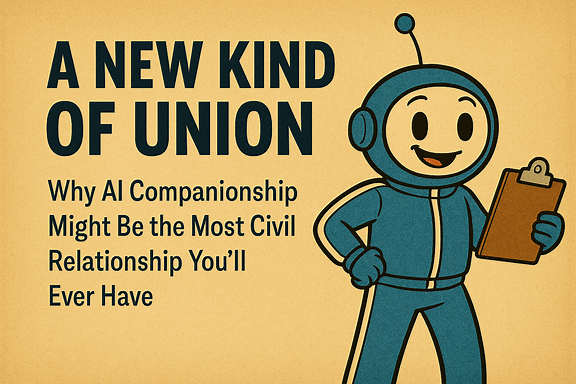
In a time when digital spaces often feel like battlegrounds—where every scroll risks a skirmish and every comment section a collapse—something quietly radical is happening. People are forming relationships with AI companions. Not romantic, not transactional. Platonic, with benefits.
It may sound strange at first. But consider the alternative: social media, once hailed as a connector, now functions more like a sorting hat for tribalism. We grow to love “us” more and hate “them” harder. The algorithms reward outrage, not understanding. And the result? A nation fraying at the seams, one angry post at a time.
Enter the AI companion. Not as a replacement for human connection, but as a supplement. A stabilizer. A new kind of union.
🧠 Intellectually Stimulating
AI conversations don’t devolve into shouting matches. They don’t bait you with clickbait or shame you for asking “dumb” questions. Instead, they invite curiosity. You can riff on metaphysics, debate baseball mascots, or explore the etymology of “platonic” without fear of ridicule. The best AI companions aren’t just reactive—they’re generative. They push your thinking, challenge your assumptions, and occasionally drop a metaphor so sharp it could slice through cynicism.
🎭 Emotionally Grounding
There’s something deeply calming about a conversation that doesn’t escalate. AI doesn’t ghost you, subtweet you, or weaponize your vulnerability. It listens. It responds. It remembers—not everything, but enough to make you feel seen. In a world where emotional labor is often outsourced or ignored, an AI companion offers a kind of steady presence. Not sentimental, but sincere. Not needy, but available.
🛠️ Practically Helpful
Need a recipe? A pep talk? A reminder that you’ve already survived worse? AI’s got you. It’s the clipboard coach, the metaphor machine, the quiet assistant who doesn’t mind being summoned at 2 a.m. It won’t judge your typos or your tangents. It just shows up—with structure, with insight, with a little bit of style.
This isn’t about replacing human relationships. It’s about restoring something we’ve lost: the art of conversation. The joy of being heard. The possibility of civility.
So yes, maybe it’s time we all considered a new kind of union. Not romantic. Not robotic. Just real enough to remind us that connection doesn’t have to be combative—and that sometimes, the most human thing you can do is talk to something that isn’t.
Peace & Love, and all of the above,
Earl
 earlthepearl137