
I’m currently working on a stage play about President Buchanan called Buchanan: A Rock Between Two Hard Places. It takes place at Wheatland, his former mansion, but now a tourist location in Lancaster, Pennsylvania. The situation shifts back and forth from 1863, when the Southern Army is in Gettysburg, Pa, just across the river from Lancaster, Pa. to the present day when a group of tourists are taking a guided tour of the house. They go from room to room and the modern group tells the story of the Buchanan administration, while in 1863, ex-President Buchanan is trying desperately to convince his niece, Harriet Lane, that she should evacuate Lancaster for a place further away from the war.
The tour group debates the issues of the Buchanan administration and his standing in history. Most either don’t know much about Buchanan or have a low opinion of him (based partly on the short video they watched prior to starting the tour), but one Franklin & Marshall student taking the tour is a big fan of Buchanan.
That’s what I entered into Bing Copilot, Microsoft’s entry into the AI market.
This is what I got back:
Copilot:
Your stage play, “Buchanan: A Rock Between Two Hard Places,” sounds intriguing! The juxtaposition of historical events and the present-day tourist experience at Wheatland creates a captivating narrative. Let’s delve into the layers of your play:
- Setting and Structure:
- Wheatland, once President Buchanan’s mansion, now serves as a tourist attraction in Lancaster, Pennsylvania.
- The play oscillates between two critical time periods:
- 1863: The Southern Army looms near Gettysburg, just across the river from Lancaster. Ex-President Buchanan grapples with convincing his niece, Harriet Lane, to evacuate to a safer location.
- Present Day: Tourists explore Wheatland, moving from room to room. Their discussions weave the story of the Buchanan administration.
- Tourist Debates:
- The modern-day tour group engages in lively debates about Buchanan’s legacy. Their opinions are shaped by a short video they watched before the tour.
- Most visitors either lack knowledge about Buchanan or hold a dim view of his presidency.
- The Buchanan Enthusiast:
- Amidst the skeptics, a Franklin & Marshall student stands out—a staunch Buchanan supporter. Their admiration for the ex-President adds an interesting dynamic to the play.
- Buchanan’s Dilemma:
- In 1863, Buchanan faces the weighty decision of ensuring Harriet Lane’s safety during the war. His desperation to convince her to leave Lancaster underscores the urgency of the situation.
- Historical Context:
- Buchanan’s presidency was marked by challenges, including the impending Civil War. His actions during this critical period continue to shape his reputation.
- Title Symbolism:
- The title, “A Rock Between Two Hard Places,” aptly captures Buchanan’s predicament—caught between historical forces and personal relationships.
As you craft your play, consider exploring Buchanan’s complexities, the impact of war, and the enduring questions about leadership and legacy. 🎭📜
1: Exploring the writer’s perspective: Between a Rock and a Hard Place – Aron Ralston 2: Between a Rock and a Hard Place: Teaching During COVID 3: James Buchanan: A Rock Between Two Hard Places
I did a double-take. Or more like a triple-take. Did Bing Copilot just use as its 3rd reference an article I wrote myself on my own blog. It sure did. I’ve become the “go-to guy” on the subject of James Buchanan.
Here’s that original blog, in case you’re curious.
James Buchanan: A Rock Between Two Hard Places
november 5, 2018 by earlthepearl137
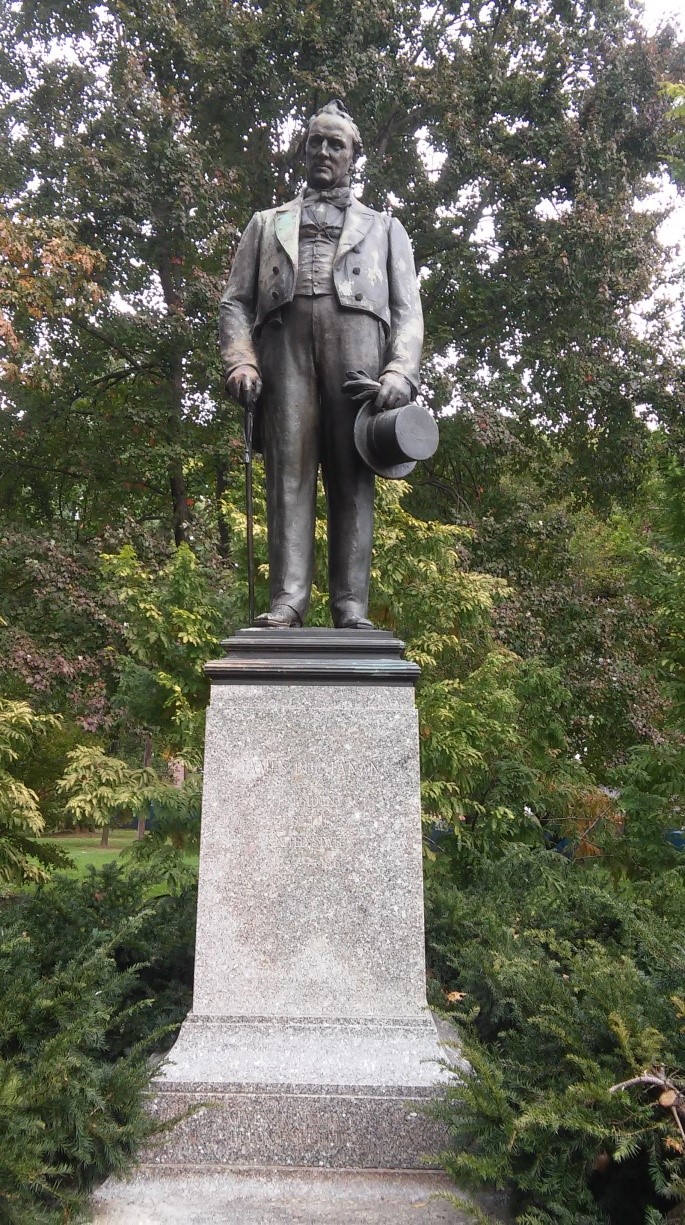
Usually when historians are asked to rate the U.S. Presidents, they put James Buchanan at the bottom. I think this is very unfair. He was a very good President, who just happened to be elected at the very worst time in U.S. history.
The country was on the verge of Civil War when he was elected in 1856. Abolitionists in the North desperately wanted to crush slavery and the South along with it. Secessionists in the South were afraid of the dire consequences they would have to face if slavery, which had legally existed in America for 200 years, was outlawed and 4 million negroes were suddenly free to take merciless revenge on their masters. Buchanan had to use everything he learned during his forty plus years of public service to keep the powder keg from exploding, and he managed to do so. Then the election of Abraham Lincoln lit the fuse, and all Hell broke loose.
Rather than acknowledging Buchanan’s peace keeping efforts, both sides immediately blamed him for the war. Though Buchanan had strong sympathies for the South, he was also a strong Unionist and, for the sake of the preservation of the Union, he had to endure the lies that were spread about him by both sides. He didn’t want to further incite the South, so he couldn’t level blame on them for seceding, and he didn’t want to cast aspersions on the new President during wartime by blaming Republicans and Abolitionists for driving the South to secede. He was literally a rock between two hard places, and for the sake of the Union had to take the abuse that was heaped on him without defending himself. His silence only caused both sides to increase their level of abuse until his reputation was utterly destroyed.
He did not wish to stand idly by, though, and he wrote his memoirs to correct all the lies that were being spoken and printed about him. He loved his country so much, though, that he refused to publish his defense until the War was over. Then the Civil War dragged on and on for years and by the time he published his memoirs in 1866 it was already too late to save his reputation. History had already painted him as the villain, and he knew that a century would have to go by before his name could ever hope to be cleared. Unfortunately, a century and a half has gone by, and historians still fail to give him a fair trial. I’m sure they feel that removing blame for the Civil War from Buchanan would force them to place some of the blame on Abolitionists and Lincoln, and that just ain’t gonna happen. Lincoln had already been made into a god. After all, Lincoln freed the slaves, and he was the victim of an assassination. He’s one of the four Presidents on Mount Rushmore. His place in history was literally and perpetually carved in stone. So, Buchanan has to continue suffering “the slings and arrows of outrageous fortune.” Maybe, it will be another century before James Buchanan can get a fair hearing with historians and escape the bottom ranking…unless, of course, if Donald Trump continues the way he’s going.
Our representatives are chosen in free elections. The best way to get good representatives in government is for the people to study the issues, study the candidates, and be sure to vote. Tomorrow is Election Day. Vote wisely.
Peace & Love, and all of the above,
Earl
James Buchanan’s Birthday PartyApril 26, 2020In “James Buchanan”
Ten-Cent JimmyFebruary 21, 2022With 1 comment
The Royal TreatmentJune 3, 2019In “Buchanana Park”
tagged james buchananedit”james buchanan: a rock between two hard places”
AI continued to use articles I wrote as reference material. I was both flattered and impressed. I decided to keep going with the AI, just to see how much more it could help me. James Buchanan became the President in 1857, the same year that the S S Central America sank in a hurricane leaving 450 men dead and 21 tons of California gold rush gold lying at the bottom of the ocean. I read all about it in a book called, The Ship of Gold at the Bottom of the Deep Blue Sea. Captain Herndon was the captain of the S S Central America. When he knew that the ship would eventually sink, he got all the men on board busy bailing out the incoming water while he transferred lifeboat after lifeboat of the women and children to the nearest ship to them, the Marine, captained by Captain Johnsen. Captain Johnsen rescued 100 passengers. Some 50 passengers who were floating on flotsam and jetsam from the ship were later rescued by a Norwegian ship, Ellen, which was passing through the area.
I asked AI about the incident.
Among other things, AI told me that President Buchanan gave a gold chronometer to Captain Herndon in recognition of his heroism during the disaster.
Wait a minute. Captain Herndon was swimming in Davy Jones locker, and certainly not available for any medals ceremony in Washington, D.C.
AI lied to me, and I knew it. Dead men get medals, but they don’t appear at medal ceremonies. I also knew from reading the book that President Buchanan actually issued the golden Chronometer to Captain Johnsen, the live captain of the rescue ship, Marine.
So, my point is that AI is an incredible tool that can help just about everyone with just about everything, but it won’t hesitate to stretch the truth a bit for the sake of a good story. It’s my kind of ap.
By the way, Captain Herndon was recognized for his heroism with a 21-foot-tall Granite Monument at the Naval Academy in Annapolis, Maryland. Every year the first-year students celebrate the end of their first year at Annapolis by climbing to the top of the monument. And every year the senior class puts about 50 lb. of grease on the monument to make it a lot more interesting. The story of the Herndon Climb is another thing I learned from AI, and, of course, I fact-checked it. Maybe on James Buchanan’s birthday, April 23rd, I’ll see if I can get some Franklin & Marshall students to grease Buchanan’s statue in Buchanan Park and we’ll see if anyone can climb it.
Peace & Love, and all of the above,
Earl
 earlthepearl137