I debated with myself whether I should write this article or not. It’s not a pleasant subject, but it does contain a valuable lesson, so I’m going to write it. I’ll try not to be too crude and I’ll keep it as brief as possible.
Several months ago I watched a show about Fascism under Mussolini. He would round up his enemies and opponents and have them marched across town. Then he would make them drink a cup of castor bean oil and march them back across town. Invariable the laxative effect of the castor oil would make them soil their pants as they walked, and they had to walk all the way across town like that. I got two things out of this video. One, dictators are sadistic and cruel. Two, Castor Bean Oil is a powerful laxative.
Since I occasionally suffer from constipation. I decided to order a bottle of it. To qualify for free shipping, I ordered 2 bottles and a rechargeable portable hand-held mini bidet. I figured the two products could both come in handy if I ever needed them.
I realized today that I hadn’t had a bowel movement in days. I was worried and I decided it was finally time to try the Castor Bean Oil treatment. I took a big gulp of it and 15 minutes later the blockage was easily eliminated without the moaning and groaning, grunting, and rapid breathing that usually accompany multi-day bowel movements. Mission Accomplished.
But, similar to George W. Bush’s mission, it was not yet complete. I had to hover in or near the bathroom for the next five hours in what I can only describe as a Colonoscopy prep without the green Gatorade.
So, what did I learn? First, I learned that the next time I am in this situation, start with just a half-teaspoon of Castor Bean oil, and secondly, I learned to make sure to charge the batteries of the hand-held portable bidet, before taking the Castor Bean Oil.
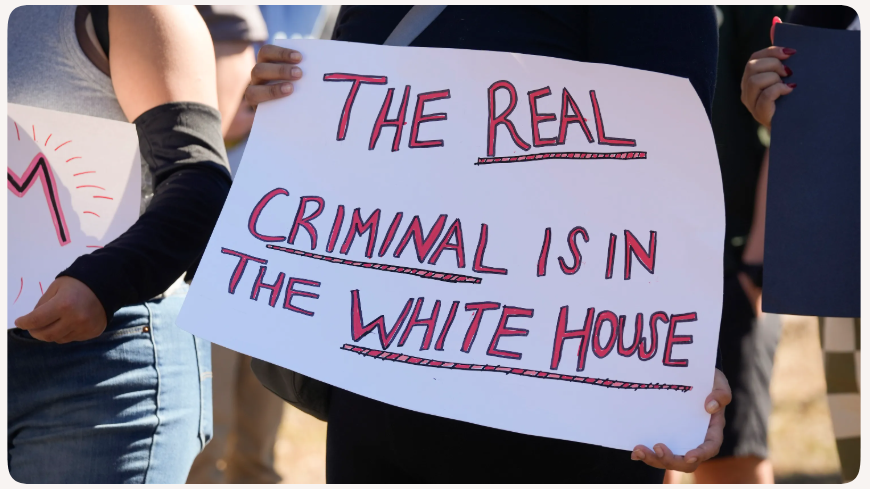
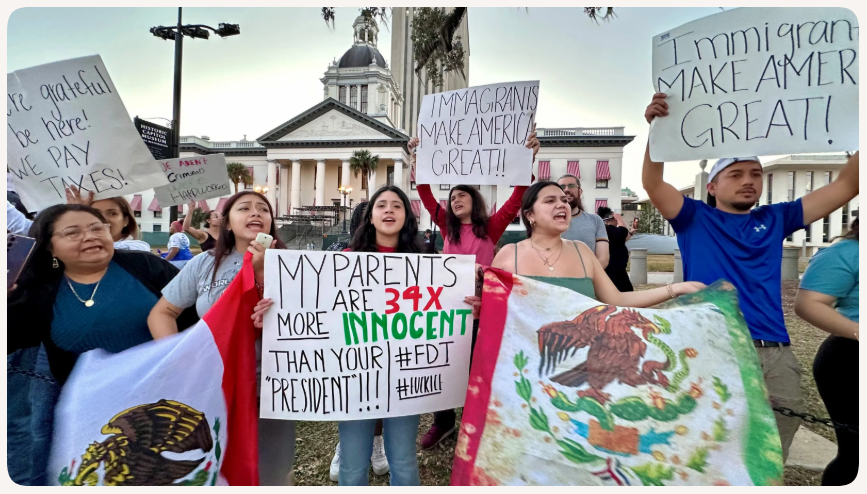
History has a way of repeating itself—not in the details, but in the echoes. As I watch the current administration deploy Marines and National Guard troops into American cities to confront protests over ICE raids and immigration policy, I can’t help but feel a chill. It’s not just the uniforms or the optics. It’s the precedent. And for me, that precedent begins not with Donald Trump—but with Abraham Lincoln.
Yes, Lincoln. The man most Americans revere as our greatest president. But I’ve long questioned that legacy. Lincoln, in my view, was a stubborn, hardheaded leader who plunged the nation into a war that cost over 650,000 lives. A war he believed would be over in months. A war he arguably provoked.
Let’s rewind to Fort Sumter. No one died in the initial bombardment. The only casualties came when a cannon exploded during the surrender ceremony—one Union soldier died. Yet Lincoln used that moment to summon 75,000 troops, escalating a regional standoff into a full-blown civil war. He suspended habeas corpus, jailed political opponents, and silenced dissent in border states like Maryland. All in the name of preserving the Union.
Fast forward to today. Trump, facing protests over immigration enforcement, has summoned federal troops into cities like Los Angeles—against the wishes of governors and mayors. He’s accepted a $400 million jet from Qatar, raising serious constitutional questions about foreign influence and the Emoluments Clause. He’s used executive power to reshape the judiciary, roll back civil rights protections, and stoke division at every turn.
And yet, like Lincoln, he claims to be saving the nation.
The parallels are uncomfortable. Both men faced divided nations. Both used federal power to suppress opposition. Both were hailed as heroes by some and tyrants by others. When John Wilkes Booth shot Lincoln, he shouted “Sic semper tyrannis”—thus always to tyrants. That wasn’t just a madman’s cry. It was a sentiment shared by many in the South who saw Lincoln not as a liberator, but as a despot.
Today, many Americans—especially those on the political left—see Trump in the same light. A man willing to tear the country apart to preserve his own power. A man who, like Lincoln, may be remembered not just for what he did, but for what he destroyed in the process.
This isn’t a defense of Booth, or of violence. It’s a plea for perspective. We must stop mythologizing our leaders and start scrutinizing them. Lincoln’s war may have ended slavery, but it also ended hundreds of thousands of lives. Trump’s war—if it comes—may not be fought with muskets and bayonets, but with executive orders, surveillance, and militarized streets.
History doesn’t repeat, but it rhymes. And right now, the tune sounds all too familiar.
On July 20th, 1969, the world watched as the United States did something that seemed impossible—we landed a man on the moon. It was the birthday of my little brother, Kevin, who’s no longer with us. I was serving in the U.S. Navy, stationed at a small communications base in Todendorf, Germany, not far from the Danish border. That moon landing was more than just a scientific milestone. For me—and for millions of people—it marked the end of one war and the beginning of something radically hopeful.
After World War I, Germany was occupied by the French. After World War II, they were occupied by the Americans. Germans resented being second-class citizens in their own land. I know; I lived it. German parents warned their children not to associate with us. German girls who dated American servicemen faced sharp social backlash. There were three bars near our base and the neighboring German army camp—each one was a nightly battleground of bruises and booze, Americans and Germans clashing like ghosts of wars we never fought.
Then the moon changed everything.
The man behind the Saturn V rocket that carried the Apollo 11 crew to the moon was a German scientist named Wernher von Braun—formerly of the Nazi regime, yes, but now repurposed for peace. America and Germany, once locked in mortal combat, had collaborated to do the impossible. On July 20, 1969, two old enemies became pioneers—the hostilities of World War II ended, and something shifted. Almost overnight, we went from occupiers to honored guests. German fathers who once wouldn’t let their daughters near us were now shaking our hands and offering schnapps as we drank toasts to the American/German achievement. Things just got really good, really fast.
It helped that the Summer of Love was going strong —and not just in San Francisco. Europe was catching the fever. The British Invasion had brought music across the Atlantic to America earlier in the decade, but now American artists were reclaiming center stage. Multi-day concerts like Woodstock were turning music into a communal ritual. Europe wanted its own Woodstock.
England hosted the now-legendary Isle of Wight Festival in late August 1970. Hendrix. The Doors. The Who. Sly & the Family Stone. Joni Mitchell. Over half a million people filled the cliffs of Afton Down and tore down the fences in protest. It was glorious madness.
Germany followed suit.
That September, the Love and Peace Festival was held on the island of Fehmarn, near the town of Putgarten. It was a short drive from our base—maybe 20 or 30 kilometers. A few of us rock n rollers who were known for public drinking and private hash smoking got our tickets early. It was going to be our Woodstock. We had no tent, no gear—just youthful optimism and a plan to get as high as possible and see Jimi Hendrix.
Friday, September 4th, 1970: we arrived cold and wet. The rain came in sheets. We pushed in close to the stage and parked ourselves in the open, surrounded by tents and strangers. The picture of Jimi performing shows the crowd and the tents. We had no cover, no shelter, just mud and music. The crowd thickened. The lights faded. We sat shivering and soaked, waiting for Jimi Hendrix, who we were told would perform that night.
A stage announcement told us otherwise—he wouldn’t go on due to the weather. He was “rescheduled” for Saturday afternoon. (Years later I found out that this was all a lie. He wasn’t actually scheduled to perform until Sunday. He was performing two shows in Munich that Friday and Saturday.)
Disappointed but too cold and stoned to argue, we sat dejected in the mud. Finally at three A.M. we were roused out of our sluggishness by Mungo Jerry singing his happy little ditty, In the Summertime. Listening to bubble gum music while we sat shivering in the mud was the last straw. We trudged through the mud, “found” a hole in the fence, located our car, and went back to base where we took long hot showers and then slept.
By late morning, we were back in the muddy field, but with raincoats and a few supplies this time. The lineup that day included The Faces with Rod Stewart and Canned Heat, among other acts, but the crowd was tired. The mud was deeper, and the promises fewer.
Another announcement: Hendrix had been moved to Saturday night. We stayed. More bands played. More rain came.
Later: Another rain delay was announced. Jimi Hendrix would play Sunday morning instead.
We were miserable. Wet. Angry. Doubting.
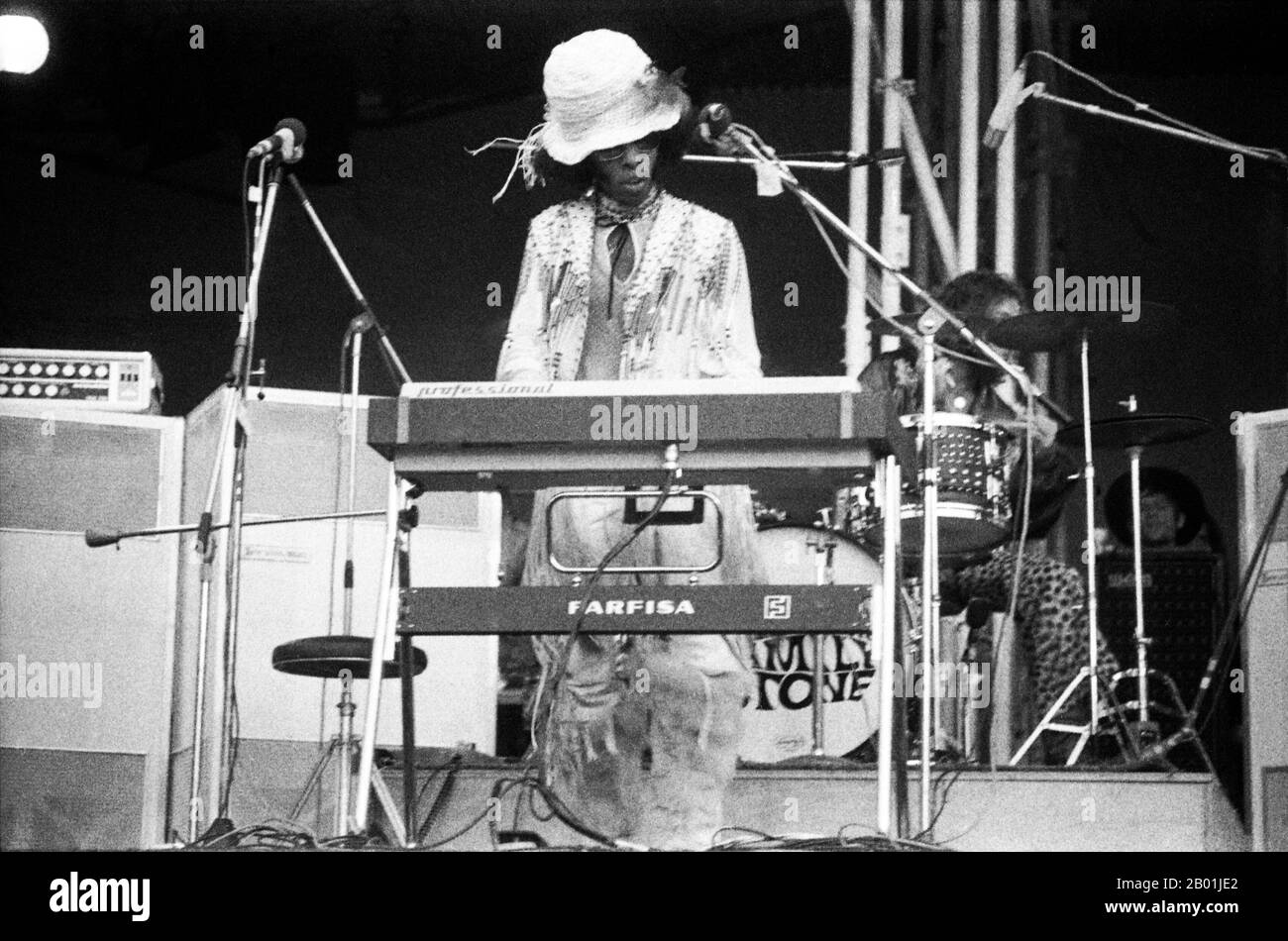
And then came Sly and the Family Stone came onto the stage.
Sly emerged in the cold and the drizzle, standing there like a priest before a congregation in despair.
“Is anybody out there gettin’ wet?” We all groaned back at him. “Could you be any wetter?” he inquired. “No!” we yelled back at him.
“Well, if you’re already soaking wet and you can’t get any wetter” he shouted, “you’ve got nothing to lose. Get up, and dance to the funky music.”
The band exploded into “Dance to the Music,” and the crowd surged into life. We stomped, shimmied, and slipped in the muck, grinning like lunatics. For a moment, we weren’t miserable. We were in it—just as much as anyone in Max Yasgur’s field a year earlier. That was our Woodstock.
Unfortunately, their set eventually ended, and we catapulted back to grim reality. We didn’t go back to base, though. We slept in the mud. We weren’t taking any chances on missing Hendrix.
Sunday morning: more announcements. Hendrix wasn’t coming out until the sun did. In for a penny, in for a pound. We waited.
And then, the sun appeared. And the moment we’d waited for arrived:
“Ladies and gentlemen, The Jimi Hendrix Experience.”
The crowd booed. They had waited in the mud for two days, and they took out their frustration on the band.
Six hundred thousand cold, wet, burned-out souls let out the anger that had grown larger with each stage announcement that Jimi wasn’t going to play in the rain. But, now, Jimi just stood there in the sunshine, took it all in, and casually said:
“We don’t give a fuck if you boo. Just boo in key. Give us a second to tune up.”
He struck a single, sharp chord. It echoed like a thunderclap across the island.
And then the spell began.
What followed was unlike anything I’d ever seen. Jimi’s hands weren’t playing guitar—they were conjuring it. Notes bent like light in a prism. Sounds came from corners of the sky I didn’t even know existed. The audience fell into a trance. When Jimi Hendrix ended his set and walked offstage with a simple “Thank you,” there was silence.
Actual silence. No one clapped. We were all dazed, slack-jawed, staring at the stage. Did we just see what we just saw, or are we tripping? When we realize that what we saw was real, the dam broke, and we roared and cheered for 10 minutes. Then 600,000 people got up to leave.
A voice from the stage: “Wait, wait! We still have six more bands! Procol Harum is next!”
No one cared. No one could follow what we had just seen. We walked away in silence, with mud on our boots and stars in our eyes.
Four days later, we got the news that Jimi Hendrix was gone, found dead in London. And now, this week, Sly Stone has joined him.
They’re headlining tonight in Rock ‘n’ Roll Heaven. And you better believe that when I hear them play, I’ll be getting up and dancing to the funky music.
Back in January, I decided that the hip pain I was feeling made the pain of a hip replacement worth my while. So, I told the VA doctor and started on the road to the surgery. What a long, strange trip it’s been.
First I had to meet with the Orthopedics department to get their assessment of my hip. They set up an appointment for x rays. The x-rays confirmed that a hip replacement was in order. But now I had to get confirmation from my cardiologist and dentist that I was cleared for surgery. I expected my cardiologist to tell me that I needed more stents or some other work done, since I’ve be sluggish for months. Nope. He sent me for two different tests and the results came back, okay. Not perfect, but okay for surgery.
Then I hit my first roadblock. I called my dentist who I haven’t seen in years and left a message. He didn’t call back. So, the following week, I left another message and again he didn’t call back. The following week I left another message and the next day I got a call from the office. They would only see me if I got a referral from another dentist. WTF. I decided to find another dentist. When I go to the VA Clinic I pass by a dental office. The bus there doesn’t run often, but the office is near the bus stop. I called, and I asked if they were accepting new patients.
There was a pause, where the person on the other end of the line wanted to say, “Duh!” but she controlled herself and just said, “Of course.” We set up an appointment.
I thought this would be easy as I didn’t have any pain, though I did have one broken tooth. The X-rays revealed that I needed more work than I thought. So, I made another appointment to get started. Now, it was time to catch the bus home. That bus stop wasn’t far, but it was on the other side of what is basically a busy highway. It was at least 10 minutes before I saw a big gap and made my move. Here, you should remember that I have a bad hip. I made it half-way across, and realized that I would have to wait for another break in traffic to complete the crossing. So, I stood in the middle of the highway with cars whizzing by on both sides waiting for a break in traffic. After about 5 minutes, a lady came out from the car repair business on the same side of the street as the dentist. “What the hell are you doing? You can’t stand in the middle of the highway.”
I yelled back that I was just trying to get to the bus stop. She shook her head, and mumbled something I didn’t understand. Finally, I saw my break and I made it to the bus stop unscathed.
After my dental appointment the following week, I decided to just catch the bus at the same stop where I got off, ride to the end of the line, stay on the bus, and ride home, instead of trying to cross the highway again. That worked. It took much longer, but it worked.
After my appointment yesterday, I realized that I had about an hour and 20 minutes before the bus would arrive. This time I brought my walker, not just a cane, so, figuring that I was now a tiny bit faster, I decided to cross the highway again. I had plenty of time before the bus would arrive, so I waited until I was sure that I had enough time to make it all the way across. It was about 15 minutes before I saw my opportunity, and I took it. I made it.
Here’s where I should mention that the bus stop doesn’t look like a bus stop. The weeds on the side of the road have overgrown the bus stop sign, and there is no shelter, marking, or anything else that would let you know that it is a bus stop, except that it is across the street from the bus stop heading in the other direction. I had my walker, so I sat down on the shoulder of the road to wait.
About 20 minutes later a cop car went by going the other direction. He waited until it was safe, made a u-turn, and pulled up a few feet behind me, lights flashing. He got out and asked me if I was okay and what the heck was I doing. I told him I was waiting for the bus. He didn’t see any bus stop sign, so I told him that the weeds were blocking it. He checked. I mentioned that I wouldn’t object if he put me in the back of his patrol car and drove me into town. He said that was against the rules, wished me luck, and drove off.
So, I went back to patiently waiting for the bus that I knew was still more than 45 minutes away. It hadn’t even passed by in the other direction, yet. Then, a woman came out of the dental office and yelled something at me. I couldn’t hear what she was saying over the traffic noise. She waited for a break in traffic and ran over to me. Was I okay? What was I doing? Once again, I explained that I was just waiting for the bus. She told me that she was waiting in the dental office with her teenage son, when she saw me through the window, she was worried that I was a dementia patient or something. I was slurring my words. I assured her that I was fine. I was just going home after a trip to the same dentist, and the reason I was talking funny was because the Novocain hadn’t worn off yet.
She asked where I lived and offered to give me a ride home. That was better than a visit from the Tooth Fairy. We crossed the highway together, with her holding out her hand to slow down the traffic. We got to her car. She called her son to tell him that she would be right back. Melisa and I headed for my house.
Along the way, we chatted and realized that we both had moved from other places to Lancaster. She was from Baltimore. It was an interesting conversation, and she told me to take her phone number in case I ever needed a ride. We realized that we both like to play Scrabble, so we made plans to get together for a Scrabble game. So, I wound up making a new friendship, and now have another Scrabble player to hang out with occasionally.
I have another Dental appointment on Thursday. I wonder if I should bring my Scrabble board.





 earlthepearl137