Educated people don’t believe in unicorns. Or mermaids. Or Atlantis, Bigfoot, or the Fountain of Youth. These are dismissed as charming myths—cultural artifacts with no empirical backing. And rightly so. We’ve combed the forests, dredged the lakes, and carbon-dated the ruins. No horned horses. No fish-women. No golden cities.
But God? That’s different.
Despite the same lack of physical evidence, belief in God is not only accepted—it’s revered. Taught in schools, sworn on in courtrooms, and invoked in campaign speeches. The same minds that scoff at fairy tales will defend divine presence with philosophical rigor and moral urgency.
This isn’t a jab at faith—it’s a spotlight on the intellectual gymnastics required to hold both positions. The educated skeptic who demands peer-reviewed proof for mythical beasts will often grant God a pass. “It’s about faith,” they say. “Transcendence. Meaning.”
But why does God get the exemption? Why not the unicorn, who at least has the decency to sparkle?
Maybe it’s not about evidence at all. Maybe it’s about utility. God offers moral scaffolding, community, and cosmic comfort. Unicorns offer glitter and horn-based combat. One gets a cathedral; the other gets a Lisa Frank folder.
So, we believe what serves us. Not what’s proven. And maybe that’s the real myth: that educated people believe only what’s true.
This isn’t a call to abandon belief. It’s a call to examine it. To ask why some unproven ideas are cherished while others are ridiculed. To recognize that even the most rational minds are shaped by culture, emotion, and need.
And if we’re going to believe in things unseen, maybe we should give the unicorn a second chance. At least she never started a war.
Let me tell you something: I used to be a man plagued by problems. Swollen ankles, dry skin, existential dread, and a rollator that squeaked like a haunted shopping cart. But then I discovered the Internet. Not the useful parts—no, no. I dove headfirst into the shimmering swamp of clickbait wellness hacks. And I emerged reborn. Possibly radioactive.
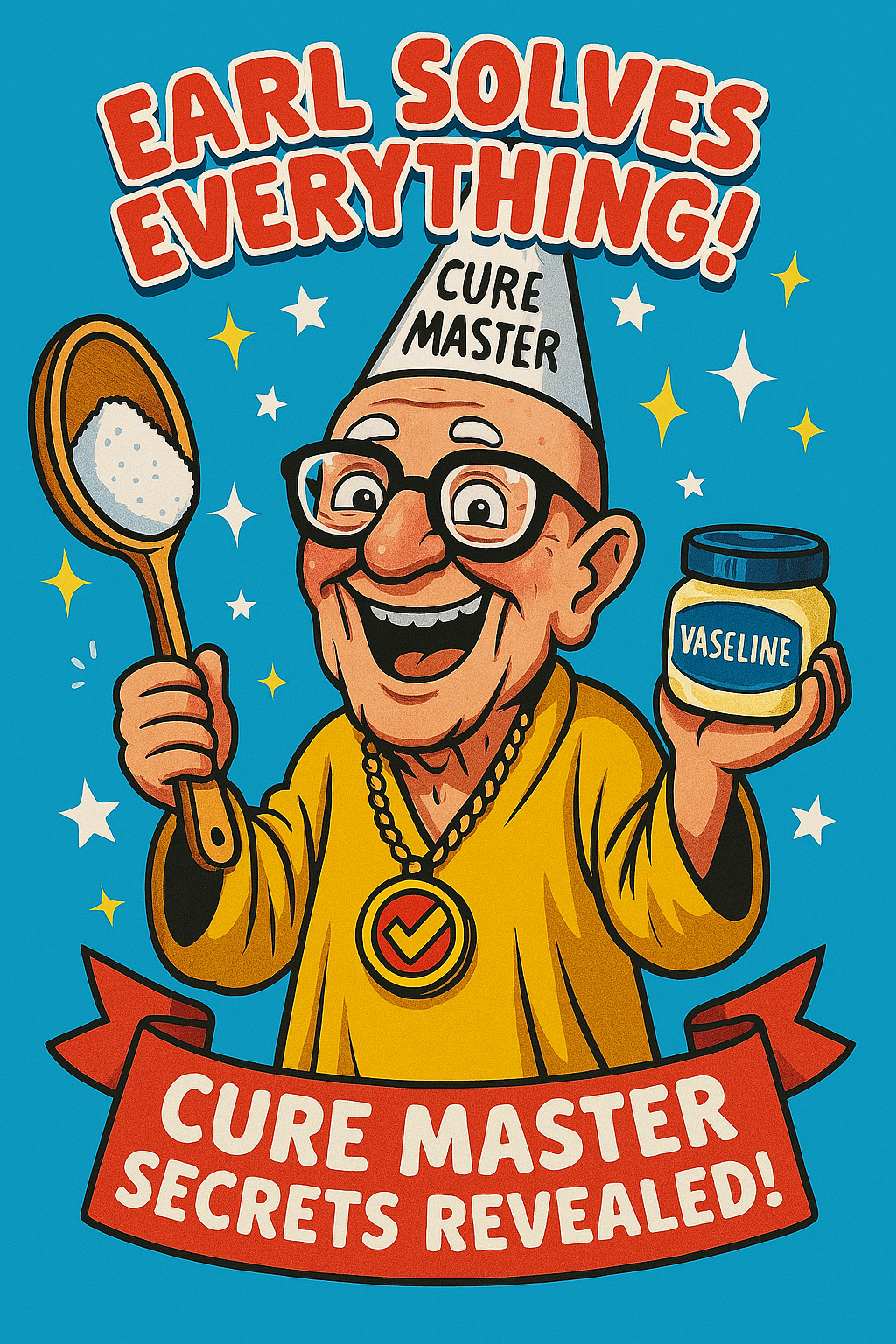
It started innocently. A headline whispered: “Dermatologists Hate Her: She Mixed Salt and Vaseline and You Won’t Believe What Happened Next.” I clicked. I believed.
I smeared the concoction on my elbows, my knees, and—at one point—my neighbor’s cat (long story, restraining order pending). My skin glowed. My pores sang. I became the unofficial exfoliation guru of Lancaster, PA.
Next came the swelling. My ankles looked like they were storing winter grain. But the Internet had my back: “Doctors Beg You to Try This One Trick Before Bed!”
It involved pressing a mystery pressure point behind my knee while chanting the phrase “Water be gone!” in Latin. I don’t speak Latin, so I used Pig Latin. It worked. Or maybe I just stopped eating pretzels. Either way, I now float like a butterfly and retain water like a sieve.
Then came the most sacred of promises: “Men Over 70 Are Raving About This Root That Restores Vitality!” I clicked. I raved. I rooted.
The cure involved a Peruvian tuber, a Himalayan breathing technique, and a YouTube video narrated by a man named “Dr. Randy.” I followed every step. My blood pressure rose. So did my eyebrows. Did it work? Let’s just say I now walk through the parking lot with a confident swagger and a strategically placed fanny pack.
The Internet has solved all my problems. I no longer trust doctors, pharmacists, or anyone with a stethoscope who doesn’t also sell supplements on YouTube. Why? Because the Internet taught me that Tylenol causes autism—a theory endorsed by two of America’s loudest unlicensed pediatricians: Donald Trump and RFK Jr.
Now, I don’t know if that’s true. I do know that after reading seventeen blog posts and watching a video narrated by a man named “Quantum Dave,” I threw out all my acetaminophen and replaced it with Himalayan salt, raw honey, and a crystal shaped like Joe Rogan’s bicep.
My ankles still swell, my skin still flakes, and my rollator still squeaks—but my mind is free. Free to believe that Big Pharma is hiding the cure for everything in a jar of Vaseline and a Peruvian root. Free to chant “Water be gone!” while pressing my knee and waiting for enlightenment. Free to click “Next Page” until I forget what I was looking for.
Next week, I’ll be trying the “Cabbage in Your Sock” method for memory enhancement and the “Toothpaste on Your Eyelids” trick for lucid dreaming. Stay tuned. Or don’t. I’ll be glowing either way.
It happened just after dusk. I was halfway through reheating last night’s chili when the knock came — firm, rhythmic, and suspiciously polite. I figured it was U.P.S. with my Bourbon order. I opened the door to find two masked men, dressed like extras from a dystopian reboot of The Blues Brothers, holding a ribboned box and wearing jackets labeled “I.C.E.”
“Candygram for Earlthepearl137,” one of them said, eyes wide with bureaucratic innocence.
I blinked. I wasn’t surprised — I’d just published a blog post titled The End of Free Speech: A Love Letter to Monitored Comedy. I knew the drill. Say something morally clear, challenge selective outrage, and suddenly you’re on the compliance radar. Satire, when done right, makes some people nervous.
In my latest post, I questioned the double standards of speech policing — how moral clarity gets labeled “aggressive,” while actual harm gets a pass if it’s wrapped in patriotism or profit. I used examples from club signage, media pivots, and the way certain phrases get flagged not for content, but for who’s saying them.
Apparently, that was enough to trigger a “courtesy check.”
The I.C.E. agents didn’t arrest me, though. They didn’t even enter. They just stood there, box in hand, waiting for me to acknowledge the delivery. It was performance art — a compliance ritual dressed as concern. And like all good satire, it left me wondering: who’s really afraid of free speech?
I reached for the candygram, and the masked man winked. Not a friendly wink. The kind that says, We know where you live.
And then I woke up.
I wonder if it was a dream or a premonition.
“No Kings Day” – October 18th. Be there and bring a friend.
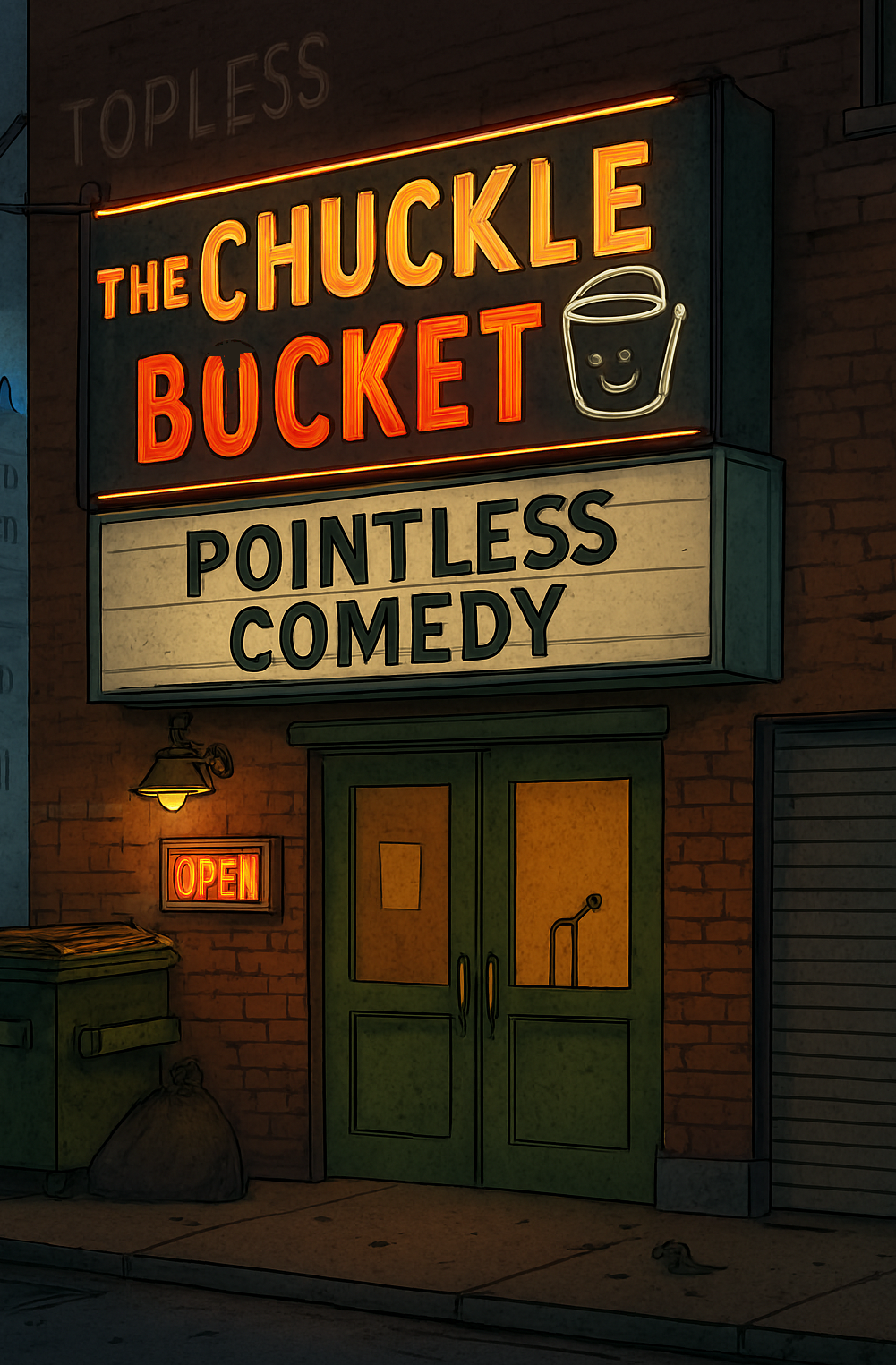
The last working bulb on the stage at the Chuckle Bucket flickered like it knew a punchline was coming. Marty’s set was one of the few that still had punchlines. The other comedians just did their 7-minute sets by conversing with the sparse audience, asking them about their problems. It wasn’t funny, but it made the handful of people in the room at least feel heard, and, in reality, that was probably what they came for. The comedy clubs were all closing ever since Trump signed an executive order that the government had to approve all jokes.
Marty still told jokes. But he was very careful about how he phrased them. “I want you to know that I love this President,” he said, “I really, really love him. I love him so much I named my ulcer after him.”
The crowd chuckled, cautiously. A laminated sign on each table read: “Please laugh responsibly.” Even the regulars, the ones who dropped in more than once a week, didn’t know what to make of that sign. Was it a joke? Or was it serious? Several times when a joke landed perfectly, a person passing by the club might be able to hear laughter coming from within. It might make them curious, but they dared not go inside. On the respectability scale, Comedy clubs were ranked somewhere between pornographic theaters and whore houses.
Marty riffed on the new Federal regulations, that he said had just come out that morning:
No impersonations can be performed unless pre-approved by the Bureau of Comedy, unless, of course, you were making fun of Democrats. Those got exceptions, except for impersonators who did Biden. It seems that too many impersonators, when they were questioned by the comedy police for doing bits where they acted like a stupid, senile old man, would just swear that they weren’t making fun of the current President. They argued that they were doing Biden. To put a stop to that defense, all Biden impersonators were henceforth outlawed.
No satire was allowed unless it was accompanied by a disclaimer that it was created using AI.”
Marty leaned into the absurdity:
“I tried to do a bit once about my uncle’s conspiracy theories. My act got flagged for ‘unauthorized nostalgia.’ My license to be a comedian was revoked for six months. It was terrible, a life without comedy. I felt like I was in Alabama.”
The audience winced. They hoped that no Republican politician from Alabama would ever hear that joke. They didn’t want Marty to mysteriously disappear like so many other comedians had.
Marty moved on. “I had a dream about the President this week. I went to my therapist and asked her if that was normal. She asked me if I woke up screaming. I said yes, and she said, Don’t worry about it, then. That’s normal.”
The four people in the audience laughed nervously.
“Don’t worry, folks. I’ve got my Passport ready.”
He looked offstage for a second. “Well, that’s my time.” He closed with the line that had become his signature—less a joke, more a eulogy:
“And remember, he who laughs Last… turns out the lights.”
He threw the switch that shut off the electricity to the one lightbulb that lit the stage, and he walked towards the bar. The four people in the room stood up, not in ovation, but in quiet recognition. Marty wasn’t just a local comic. He was the custodian of what used to be funny.
I went to my Aunt Miriam’s funeral in Ohio last week. Naturally, it was a sad occasion, but it still had it’s lighter moments. That’s one of the benefits of the deceased being 91 and someone who we knew had lived a full life. My Aunt survived my Uncle George by 5 years, but in her final months she was losing her memory and fading quickly. So, while it is always sad to lose someone, it wasn’t a big surprise when she passed. So, the funeral, while solemn, felt more like a family reunion, only with less alcohol.
Decades ago, I realized that drinking and driving was a very dangerous combination, so, putting safety first, I gave up driving. Luckily for me, my brother Donald was driving to the funeral from his residence on Long Island, New York, and he agreed to stop in Lancaster on Sunday to pick me up. He even showed up with breakfast. What a good brother.
Most people just use GPS to get to their destination. My brother Donald also drives with a set of self-imposed rules. He likes order, predictability, and structure. I’m more loosey goosey. So, our road trip was a study in contrasts. He had everything planned out. I was in road trip mode, just ready to see what the road had in store for us. Donald’s girlfriend, Kathleen wanted to attend the service, but she had to work on Sunday. They worked out a plan. Donald would drive to Akron. When she got off work, Kathleen, ever the jet-setter, would fly to Akron with a short layover in Washington, D.C. Donald would pick her up at the Akron airport.
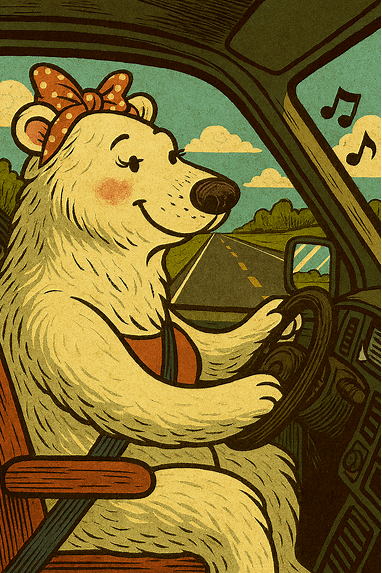
We got to Akron around 5 p.m. and Kathleen’s flight wouldn’t arrive until 9 p.m. I suggested we go to the hotel bar, where we could grab something to eat and watch football. Don agreed, but because he had to drive to the airport at 8:30 he would only have one drink. I, once again, thanked my lucky stars that I had made the right decision decades ago to quit driving, so I didn’t have to stop at just one drink. “Kathleen likes the room to be cool,” Don said. So, we cranked up the a/c before we headed to the bar. I’m not a big fan of air conditioning, but I knew that I would be able to stock up on “anti-freeze” at the bar, so I readily agreed to pre-chilling the room for her. Donald let me continue watching football when he went to pick up Kathleen. We entered the room, and I felt like I had walked into Superman’s Fortress of Solitude in the Arctic Circle. Donald showed no reaction. Kathleen loved it. I put a jacket on and asked if we were expecting a family of penguins to drop by for a visit. I remembered that Donald and Kathleen met while both of them were on vacation in Iceland in January of 2024. Iceland in January. She must really love the cold. I wondered if she might be part polar bear. Anyway, we turned in early and I slept well under a thick layer of sheets, blankets, and bedspreads.
We got up early, had breakfast, and headed off to the funeral. There we met all our Ohio cousins. The wake was held in the entrance of the church. After an hour, everyone moved into the church for the funeral mass. I found a spot close to an exit, just in case the walls couldn’t withstand my Atheistic vibrations. After the service, we all went across the street for a funeral luncheon, and then it was time to get back on the road home.
On the return trip, Donald drove the first 60 miles and made two wrong turns because the GPS wasn’t prepared for the Ohio traffic circles. We all laughed the first time, when the GPS immediately responded with, “Make the first U-turn.” After we came out of the wrong section of the next traffic circle, however, only Kathleen and I laughed when the GPS again responded with “Make the first U-turn.” We teased Donald. One of his rules of the road is don’t poke the driver, and we were both poking him quite a bit, when he responded with something that upset Kathleen. I suggested he apologize. Instead, he executed a silent transfer of power: He stopped the car, climbed into the back seat, and handed her the keys. He was trying hard to give us the silent treatment, but Kathleen and I just began singing along to the oldies on the radio, and we used some serendipitous lyrics to lob good-natured jabs at Donald, “Come on you people now. Smile on your BROTHER. Everybody get together. Got to love one another right now.”
Another of Donald’s rules on a road trip is that we stop every two hours for a restroom break.
Kathleen was driving, and we were approaching one of the rest areas, which are spaced about 40 miles apart on the Turnpike. This was supposed to be our scheduled stop. Kathleen, looked at me and quietly asked me if I had to go to the bathroom. I shook my head “No.” “You?” I asked. She shook her head, no.
“Ooops! I missed the entrance ramp for the rest stop,” she said as we cruised by the rest station. Donald had to hold his water for 40 more miles. The power had shifted, and that ended the silent treatment. Peace was quickly restored. We pulled into the next rest stop, and everyone was relieved in more ways than just number one. We got back in the car, and all three of us were now singing along to every song on the radio, even when we went through tunnels and the satellite radio cut out. We were back in perfect harmony, even if we might have sounded more like the Karaoke crew from hell. The next thing you know, we were in Lancaster, and we stopped at a diner to get something to eat, and laugh about “what a long, strange trip it was.”
This trip had rules, yes. But it also had rhythm. And quite a bit of laughter. It had the kind of shared absurdity that turns a trip into a fond memory. Donald may live by rules, but Kathleen and I didn’t always follow them—and together, that made the road a little warmer. Even when the AC said otherwise.
Today marks the anniversary of September 11, 2001—a day of unimaginable loss. Nearly 3,000 Americans were murdered in coordinated terrorist attacks. The grief was real. The fear was justified. But the response? It became something else entirely.
In the name of justice, the United States launched the War on Terror. Over the next two decades, that war claimed the lives of more than 363,000 civilians across Afghanistan, Iraq, Syria, Yemen, and Pakistan. The total death toll—including combatants, journalists, and aid workers—approaches 900,000.
These were not accidents. They were the result of deliberate policy, drone strikes, invasions, and occupations. And they were justified with the same language we hear today: “threats,” “terrorists,” “national security.”
Fast forward to this week.
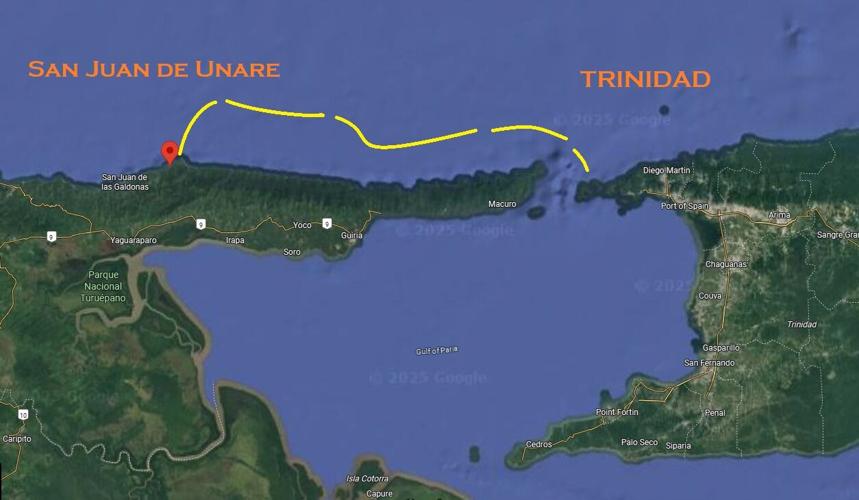
President Donald Trump bragged about ordering a strike that killed 11 Venezuelans on a boat suspected of drug smuggling. No trial. No names. Just a video of the explosion and a caption: “BEWARE.”
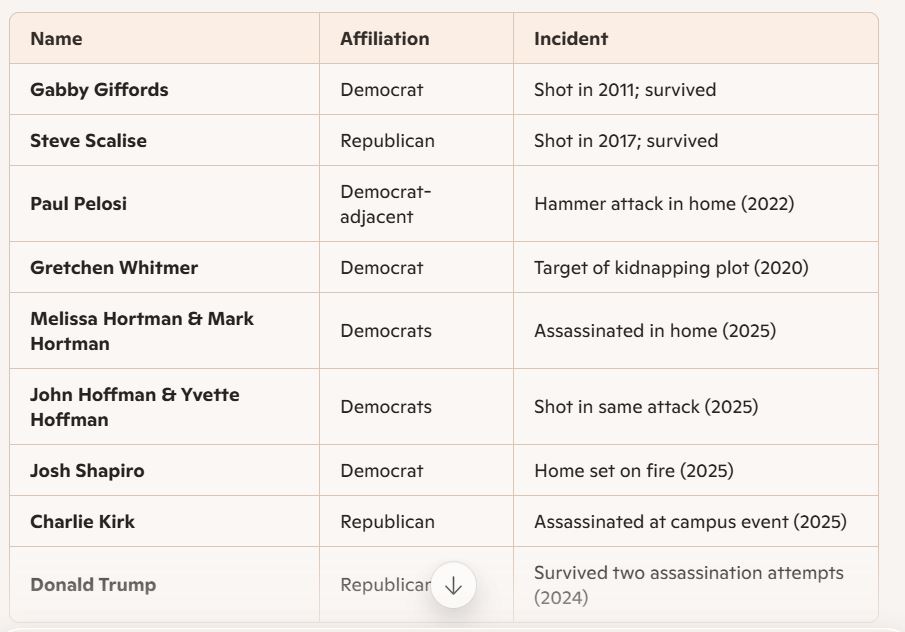
Days later, Charlie Kirk, a conservative activist, was assassinated while speaking at a university. Trump responded with solemnity, grief, and fury—calling Democrats “terrorists” and promising retaliation.
This is not just hypocrisy. It’s a moral collapse.
A pacifist sees murder as murder. Whether it’s by drone or by gun, whether the victim is a political ally or adversary, the moral cost is the same. The selective outrage—grieving one death while glorifying another—erodes our shared humanity.
The War on Terror didn’t just avenge 9/11. It multiplied its death toll a hundredfold. And now, in 2025, we see the same pattern: state violence is celebrated, while personal violence is condemned—but only when it’s politically convenient.
🧭 What We Must Refuse
Refuse to let grief be weaponized.
Refuse to let state violence be sanitized.
Refuse to let political affiliation determine moral worth.
If we mourn Charlie Kirk, we must also mourn the 11 Venezuelans. If we condemn his assassination, we must also condemn the strike that killed them. If we remember 9/11, we must also remember the civilians who died in its name.
Otherwise, we are not defending life. We are defending a brand.
They were brown men. Poor men. Fishermen, smugglers, fathers. Not cartel kings. Not warlords. Just convenient bodies in American Power theater.
San Juan de Unare was never meant to be a headline. It was a village of salt and sun, where boats bore names like Esperanza and La Fe, and the sea was both cradle and coffin. The men rose before dawn to fish. The women salted the catch and mended the nets. Children learned the tides before they learned their letters.
But poverty is a tide that doesn’t recede. And when the Venezuelan state abandoned the coast, others arrived—armed, organized, and hungry for routes. The village became a corridor. The boats once used for snapper and sardines now ferried cocaine and migrants. The fishermen didn’t become criminals overnight. They became desperate. And desperation, in the eyes of empire, is indistinguishable from guilt.
So when the Trump regime needed a distraction— a flex, a flourish, a headline—A real live version of Hollywood’s Wag the Dog, they reached across borders, bypassed international law, and turned a forgotten village into a theater of war.
Eleven lives extinguished in a flash, not for what they carried, but for what they represented— a convenient target, a distraction, a spectacle.
The strike wasn’t surgical. It was symbolic. A criminal president, facing scrutiny and scandal, chose brown bodies for his stage. Not in Manhattan. Not in Mar-a-Lago. But in a village no one had heard of, and few will remember.
San Juan de Unare is now a ghost with a pulse. The sea still laps the shore. The nets still hang. But the air is heavy—with grief, with fear, with the knowledge that the world only noticed them when it was time to kill.
This wasn’t justice. It was theater. And the poor brown men of San Juan de Unare were just props.





 earlthepearl137