WordPress sent me one of those algorithmic love notes: “You might like this blog as much as they liked yours.” It’s their way of nudging bloggers into polite reciprocity. When I first started my blog, 100% of my readers were close personal friends. Now, 90% of subscribers are other WordPress bloggers. She liked mine, so I clicked her link.
Her site was called _______IsAChristian. I won’t use her real name—let’s just say it was unmistakably evangelical. Now, I’ve been an atheist for twenty years, and an agnostic for twenty before that. So I approached with caution. But etiquette is etiquette. She liked my blog. I owed her a visit.
Her post was a long, winding story about her church group making sandwiches for people on the street. The kind of tale where the sandwiches are almost incidental. The real star was God—God in the bread, God in the mustard, God in the sidewalk. I read about two-thirds of it. That’s more than I give most stories.
Somewhere along the way, I left a comment. I said I wouldn’t try to debate her religion the same way I wouldn’t tell a child there’s no Santa Claus. It was a simile. It was also a little snide. But it was honest. I wasn’t trying to be cruel—I was trying to explain why I wouldn’t debate her beliefs. I figured she’d appreciate the boundary.
I followed up with something more generous: “As an atheist, I wasn’t moved by the religious framing, but I was moved by your group’s compassion for the hungry.” I meant it. The sandwiches mattered. The kindness mattered.
She replied: “You don’t love Jesus as much as I do.” And then more sermon. Less sandwich.
I commented one last time: “Bye.” And unsubscribed.
Then came the final message. A digital benediction wrapped in barbed wire:
“It was pleasure meeting, but I would be so blessed if you deleted me as a subscriber, so I don’t have to hear your negative comments on my posts because I don’t care about you, bye.”
My first reaction, of course, was “F*** you,” but I’ve learned to count to 10 when I’m mad. My second reaction came after 2 or 3 reps of Seated Marching exercises. Ten counts on each leg. My final reply was simply “Done and Done. Bye.”
I’m telling this story from my point of view, of course. I imagine hers would be very different. Maybe she saw me as the Grinch who stole her comment section. Maybe she felt invaded. Maybe she just didn’t like the Santa Claus line.
But here’s the thing: I saw kindness in her actions. I saw people feeding the hungry. I just didn’t see the need to wrap it in theology. And maybe that’s the real divide—not belief, but packaging.
Sandwiches and Santa Claus. One nourishes the body. The other comforts the soul. And sometimes, both come with a side of unsubscribe.
Back in the day, our basement wasn’t just a hangout—it was a teenage Shangri-La with vinyl grooves, checkerboard tiles, and just enough parental distance to feel like we were living on the edge. My brother and I would head down there with our friends to spin records, swap stories, and—unbeknownst to each other—conduct covert operations involving Dad’s liquor cabinet.
We weren’t throwing wild parties or reenacting scenes from Animal House. No, our rebellion was more… artisanal. A sip here, a splash there. Just enough to feel like we were pulling off a heist worthy of a Saturday matinee. And we had a system: mark the bottle with a crayon, take your sample, top it off with water, and erase the evidence like a magician with a disappearing act. Genius, right?
Except we were both doing it. Independently and repeatedly. By the time Dad poured himself a highball, it had the alcohol level of a snowball. His bourbon gradually became as colorless as gin with less kick than a Shirley Temple.
Our parents were highball aficionados—elegant glassware, fizzy mixers, and drinks so gentle they could’ve been served at a toddler’s tea party. The real excitement came during neighborhood card nights. At our house, the games were quiet, strategic, and sober—unless someone brought beer, which we hadn’t yet figured out how to misappropriate. But when the party moved down the block to a neighbor’s house — That’s when the cards flew, the rules bent, and the laughter spilled into the street like a runaway keg. We could hear them singing from a block away, and we knew: those folks weren’t sipping watered-down whiskey.
It wasn’t until last month, during a visit with my brother, that we finally compared notes about our teenage years. We were mildly surprised that we’d been running parallel bootlegging operations like two competing moonshiners. We laughed until our ribs hurt—not just at the memory, but at the sheer absurdity of thinking we’d fooled anyone. Dad probably knew. Maybe he even preferred his bourbon with a splash of sibling sabotage and a twist of teenage ingenuity. Maybe he was glad nobody got rip-roaring drunk in our house.
I almost got kicked out of a diner once for trying to order a Jim Beam milkshake with my breakfast. The waitress said it violated “company policy.” I said it violated my taste buds to drink anything without a little rebellion in it. We settled on a root beer float and a mutual understanding that rules are only flexible when the manager’s on break.
Which brings me to Alaska.
Whoever is running this country must be on a break. This Friday, two men—one a convicted felon, and one wanted in 125 countries for war crimes—will meet at a Hotel in Alaska to discuss peace, war, and possibly who gets custody of Crimea. Donald Trump, who is the only U.S. President with felony convictions, will host Vladimir Putin, a man wanted by the International Criminal Court for abducting Ukrainian children. He is wanted in 125 Countries, while Donald Trump is unwanted everywhere he goes.
Now, before you ask, “How is this legal?”—let me remind you: the United States isn’t part of the ICC. We opted out, presumably to keep our own war crimes tidy and domestic. So while 125 countries would slap cuffs on Putin faster than you can say “borscht,” Alaska rolls out the welcome mat. Probably one with a bear on it.
I imagine the summit will be held in a Bail and Breakfast place, with moose jerky appetizers and a ceremonial exchange of MAGA hats and Kremlin lapel pins. Trump will declare peace in our time, Putin will drink Vodka and nod solemnly, and somewhere in The Hague, a judge will throw a gavel at the wall. Or maybe one of Putin’s political opponents will vigorously protest by “accidentally” throwing himself off a 30th-floor balcony.
This is not diplomacy. It’s dinner theater.
And yet, there’s something heartbreakingly American about it. We love a good outlaw. Jesse James. Al Capone. Butch Cassidy and the Sundance Kid, not to mention the guy who invented the McRib. We don’t mind criminality as long as it comes with a slogan and a side of fries. Trump and Putin are just the latest duo in our long tradition of “bad boys with branding.”
But here’s the rub: this isn’t a sitcom. It’s real. Ukraine is bleeding. Children have been taken. Democracy is being bartered like a used snowmobile. And while the rest of the world tightens its grip on justice, we’re hosting a summit meeting between two known criminals. The only result anyone expects is for Putin and Trump to issue a joint nomination for the Nobel Peace Prize—submitted in black Sharpie and sealed with a vodka stain.
I woke up not on a cushiony cloud of air but with a hardwood frame pressing against my arthritic hip. That’s to be expected occasionally from air beds, though, so I just rolled out of bed and looked for my air bed repair kit. While I wandered around the house looking for my repair kit, I recalled a fond memory.
It was 1980, and my marriage was on the rocks. We had been separated for three years, and Ginny wanted a divorce. I hesitated, and she sweetened the deal: “Sign the divorce papers, and I’ll take you on vacation to Jamaica.” I asked only one question: “Does the hotel have a pool?” She said yes. I signed.
Now, this wasn’t just about tropical leisure. I had a mission. The king-sized airbed I slept on back then had recently sprung a leak, and every morning I woke up on hardwood instead of a heavenly cushion of air. I’d tried everything—soap bubbles, flashlight tests, even listening for whispers of escaping air. Nothing worked. I couldn’t find the leak, and if I couldn’t find it, I couldn’t fix it. But I had a plan: if I could get that bed into a pool, I could find the leak.
So I stuffed the deflated bed and a bathing suit into my suitcase and flew it to the Caribbean with Ginny.
Once we arrived, I inflated the beast and floated it in the hotel pool like a proud inventor testing his prototype. And there it was: the elusive leak, bubbling up like a confession. I patched it, let it dry, and suddenly we had a giant floating mattress perfect for ocean paddling. We spent the entire week drifting, laughing, and—somehow—rediscovering a spark. We even had sex regularly, which was more than we managed during the actual marriage.
We didn’t reconcile, but we did become friendly again. Divorce papers were still signed, but now we had a shared fresh memory of good times.
We were staying at a resort in Ocho Rios, the kind with orange rooftops, endless rum punch, and a view of a tiny offshore island crowned with a stone turret and three cabanas that looked like they’d been designed by a romantic pirate. Tower Isle, they called it. Clothing optional, they whispered.
We didn’t have a boat, but we had a big red airbed—tufted like a Victorian fainting couch and twice as ridiculous. We launched from the beach with the grace of two determined manatees, paddling with our hands and a sense of purpose that bordered on delusional.
The water was warm, the sun forgiving, and the raft surprisingly cooperative. Locals waved. Somewhere along the way, we invented synchronized paddling and declared ourselves the champions at it. We laughed so hard we nearly capsized.
Tower Isle loomed closer. The cabanas stood like sentinels. The tower watched us approach, unimpressed. We didn’t storm the beach so much as gently bump into it, while waving sheepishly at a couple who were decidedly less clothed than we were.
We didn’t stay long. Just long enough to say we’d been there, to feel the thrill of the forbidden, and to paddle back with sun-kissed shoulders and a story that would make us laugh for years.
Then came the airport.
Customs took one look at my deflated bed and raised an eyebrow. “What’s this?” “An airbed,” I said. “I brought it here to fix a leak.” They weren’t buying it. They wanted me to cut it open. “No way,” I said. “This bed and I have been through too much.” They insisted. I refused. I suggested drug-sniffing dogs. That’s when I felt a kick.
My ex-wife, now nervously jabbing me in the shin, whispered, “Just let them have it.” “No,” I said. “This is my bed. I love it. It’s finally not leaking. I’m not leaving it.” She kicked harder.
Eventually, customs gave up. They felt the bed, deemed it empty, and let us board. On the plane, I turned to her and asked, “Why were you kicking me?” She confessed that she had two ounces of pot tucked into her bra and was terrified the dogs would sniff her out. I was defending my mattress like a knight guarding a castle, while she was praying the hounds wouldn’t sniff her stash.
I laughed. She didn’t.
And that, dear reader, was my divorceamoon in Jamaica: a week of patching things—beds and relationships. I came home with a fixed airbed, a friendlier ex-wife, and a story that’s been floating around ever since.
Her birthday was last week, but I didn’t send her a card, because I don’t know where she lives. I haven’t heard from her in over a decade, but I still remember that the best vacation of my life was on our Divorceamoon.
We were taught to respect him. He wore a tie to breakfast. He had opinions on everything from foreign policy to potato salad. He shook his head at protests, praised moderation, and told stories where he was always the hero.
He was The Adult in the Room.
He built systems that favored the seasoned and the serious. He spoke in spreadsheets and nostalgia, mistaking legacy for wisdom. He said youth should “wait their turn,” even as the clock ticked toward irreversible climate change, social fracture, and another news cycle full of grief.
When the world caught fire, The Adult offered a lecture. When the oceans rose, he proposed a committee. When children cried out in fear or fury, he complimented their passion… and resumed business as usual.
But then something shifted.
It started small—barely audible under the weight of legacy. A 14-year-old refused to buy another plastic bottle. A class of 10-year-olds planted trees where asphalt had smothered their playground. Teens organized online, flooding streets not with rage, but with resolve. No party lines. No lobbyists. Just clarity.
They didn’t shout down The Adult. They simply stopped listening. They acted instead.
And it wasn’t the first time.
Youth had moved mountains before:
In the 1960s, college students rode buses into segregated towns and risked their lives to register voters.
In Soweto, 1976, students stood up to apartheid and faced down bullets so future generations might breathe freer air.
During the Arab Spring, youth ignited democratic sparks with nothing but hope and handheld devices.
After Parkland, high schoolers led marches that rattled Capitol steps and dinner table conversations across America.
Greta Thunberg sat alone—then inspired millions.
And in Uganda, young community reporters taught us that poverty isn’t hopeless if you let voices rise from the ground up.
They weren’t waiting for the world to be better. They were making it so.
The Adult in the room realized that if the world were a house on fire, youth weren’t fleeing through the exits—they were grabbing the hoses. They weren’t reckless; they were relentless. They weren’t naïve; they were awake. Where others saw smoke and chaos, they saw a chance to rebuild. They didn’t wait for permission to act—they became the response.
In boardrooms and parliaments, The Adult kept raising his hand. But votes no longer waited for him. In classrooms and studios, youth painted visions that didn’t center on him. On social media and city squares, they chanted not for power, but for possibility. They didn’t ask permission. They asked what’s next.
And gradually, The Adult in the Room grew quieter.
Not out of defeat, but recognition.
One day, at a summit meant to “restore order,” the Adult arrived early. He sat, tie knotted, notes prepped. But when the session began, something was different.
The chairs were filled with young voices. The agenda had changed. And for once… He chose to listen.
The Adult in the Room saw business opportunities, but not the damage those businesses brought to society. A fresh, altruistic approach is the only way forward—and that must come from the youth. It was young protesters who helped end the war in Vietnam. It is youth who helped end apartheid, who demanded civil rights, who called out for justice from Tunisia to Tallahassee. Now, youth movements can get us back on track to saving the planet, and saving ourselves.
“Come mothers and fathers Throughout the land And don’t criticize What you can’t understand Your sons and your daughters Are beyond your command Your old road is rapidly agin’ Please get out of the new one If you can’t lend your hand For the times they are a-changin'” – Bob Dylan
There’s a certain kind of courage that doesn’t come with a cape or a podium. It comes quietly, in the form of a resignation letter and a warning. Sarah Matthews didn’t shout. On January 6th, 2021, she simply stepped away—and pointed toward the storm.
Back in the waning days of the Trump administration, Matthews, then deputy press secretary, made a prediction that many dismissed as dramatic. She warned that if Trump returned to power, the second term wouldn’t be staffed by seasoned professionals or principled dissenters. It would be a loyalty test. And the only passing grade would be blind devotion.
Fast forward, and her forecast reads like a script. Cabinet picks with résumés built on cable news appearances. Health officials who treat science like a suggestion. Intelligence leaders who think nuance is for the weak. Matthews didn’t name names—but the names filled themselves in.
And now, the Epstein files have cracked open a new chapter. Trump’s name, redacted and then revealed, has stirred unease even among his most ardent supporters. The man who once promised transparency now finds himself dodging questions about flights, friendships, and fallout. The MAGA faithful—some of them—are beginning to ask: What did we miss?
Here’s where the story takes a turn. Not into mockery. Not into smugness. But into grace.
To those who are seeing the light—not because they were forced, but because they chose to look—we say: Welcome. It’s not easy to admit you were wrong. It’s even harder to change course when the crowd is still marching. But history doesn’t reward stubbornness. It rewards reflection.
Matthews didn’t just leave the room. She lit a lantern on the way out. And now, as more people follow that glow, we have a chance to do something rare in politics: forgive.
Not forget. Not excuse. But forgive.
Because if democracy is to survive the storms, it needs more than warnings. It needs bridges. And if those bridges are built by former MAGA supporters who now stand for truth, then let’s walk across them together.
Matthews saw the storm coming. She told us. And now, as the clouds begin to part, maybe we can all agree: it’s time to build something better.
The time has come to stop mocking the victims—whether young lives scarred by abuse or loyal souls deceived by false hope—and start healing the wounds left by a leader who never deserved their trust. Take a pass on the Kool-Aid, and enjoy a refreshing drink from the fountain of truth. Cheers!
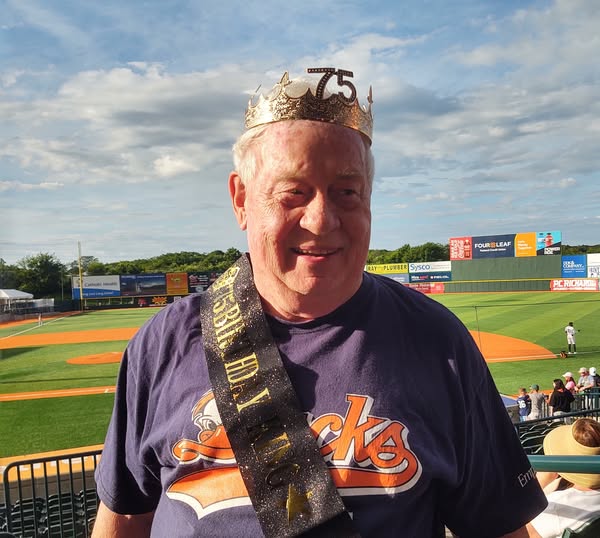
When Brother X—known in legal circles as Donald—turned 75, he didn’t ask for much: just a day at the ballpark with 50 people who mattered. For a man whose influence spreads through family trees, Lions Club meetings, and neighborhood barbecue debates, this was no ordinary birthday. This was a coronation.
But before the crown and sash came the journey. Since his family frowns on him taking long road trips alone, Donald and his daughter Beth arrived in Lancaster Thursday night so they could pick me up Friday morning and avoid a round-trip marathon in one day. Beth, a cop, rode up front. I climbed into the back—on the right side. I stand facing the road and back into the seat. Then I push myself as far into the vehicle as possible with my good right leg. I hit an obstruction, an arm rest, so I raised it and pushed again. Success, so, I swiveled to adjust myself into the seat and I was ready to go.
“Where’s that coffee you promised?” I asked.
“In the armrest,” he said.
Oops. I pulled the arm rest down, only to discover that half the cup had already christened the upholstery. Auspicious beginnings as Jack Nicholson said in the movie Five Easy Pieces. Brother X cleaned up the mess, and I laughed and ate the bacon, egg, and cheese sandwich, which he also provided. We took the slow but scenic route out of town and had clear sailing until we got to New York—specifically, the Belt Parkway, which transformed into a parking lot with signage.
Beth, ever the navigator, detoured us through Flatlands, where she had worked when she first joined the N.Y.P.D. Traffic still crawled, but at least it was scenic. We finally reached Seaford just shy of 3 p.m.
With our concert plans for the evening canceled, Donald asked me what I wanted to do. I’d never seen Ted Lasso but had heard enough to know it might be the perfect show to binge-watch in whiskey-soaked solidarity. Donald had already seen all three seasons—but gladly rewatched them with me.
We binged season one. We cracked open the Jack Daniels he bought for my birthday in August. It was classic Paulson bonding.
Saturday was Game Day. Brother X removed the baby seat from the car, added his late wife’s rollator for me, and Kathleen (his girlfriend, who he met in Iceland in January) and Beth joined us for the ride to Commack. That ballpark is special to him because one year when he was named one of the six Seaford Patriots, for his work in the community, one of the perks was throwing out the first ball at the Commack stadium. At the ballpark, we joined 47 of Donald’s friends and family. (One missed due to illness.) They handed him a sash: “Happy 75th Birthday” and crowned him with a metal tiara marked with a bold 75. When it looked like a thunderstorm might pass by, I encouraged him to take off the metal crown he was wearing and hold it up high in the air. Sarcasm is also part of the classic Paulson bonding.
Many of his friends were also turning 75, so Donald paid for their names to appear on the jumbotron after the second inning. It was festive, chaotic, and beautiful—even if the Ducks lost 7–2 to the Dirty Birds.
For Sunday, Donald had arranged a memorial mass for our late brother Kevin, a gay police captain and columnist for the San Francisco Chronicle, who would have been celebrating his 67th birthday that day. Kevin wrote eloquently about his life with partner Brian and their adopted sons—Zane, who danced too close to the law, and Aidan, a shy, quiet soul now making his way through college. Kevin once said he took inspiration from former Chronicle columnist Mark Twain, who warned, “Never let the truth get in the way of a good story.” I think Kevin held a higher rank than Captain, but I, too, never let the truth get in the way of a good story.
As an atheist, I was lovingly excused from church. Instead, I slept in and later, X and I taught Kathleen how to play pinochle. After she took all our money, we went back to our Ted Lasso marathon.
Kathleen bought me two big bottles of Moscato Sangria. On Monday, we drank wine, ate Chinese takeout, played more cards, and finished season two of Lasso. It was comforting, light, and full of laughter.
On Tuesday, Don and I visited my best friend John, now undergoing chemotherapy. His body had shrunk, but his wit hadn’t. We joked, talked Yankees, and filled his “recovery room” with laughter. It was the kind of visit that sticks to your ribs, even more than the sauerbraten we ate later at Das Bierstube, which I call “Das Digs” combining the old and new names of the bar/restaurant.
My mother’s sauerbraten was the stuff of legend, even outshining what I once tasted in Germany. So we go out for sauerbraten not for flavor, but for ritual: to remember her, to compare notes, and to declare—again and again—that no chef measures up.
That evening, we had hibachi at D.J.’s house. I was too full to eat but not too full to drink. We sipped beers while Cooper and Chloe ran wild in the backyard, turning it into a small summer paradise.
Back in Seaford, Donald and Kathleen went to bed, but I stayed up until 4 a.m. finishing Ted Lasso. I needed that final episode. I needed to feel what Coach Lasso felt when the journalist handed him the book: The Lasso Way.
But Ted had it right. He renamed it The Richmond Way. Because it wasn’t about him. It was about all of them.
We left Seaford at 10 a.m. and arrived in Lancaster by 2. Kathleen treated us to cheesesteaks and a hamburger from the shop across from my house. Then she and Donald went to their hotel for a swim and some sleep before heading back to New York.
The Seaford Way is not about Donald alone. It’s about Beth, with her grit and grace. It’s about Kathleen, who learns card games and brings sangria and cheesesteaks. It’s about Kevin, who kept stories alive, even beyond truth. It’s about John and DJ, Stacy and Cooper, Chloe and sauerbraten—and yes, it’s about me, too.
But mostly, it’s about the people who show up. It’s about how Coach Lasso said goodbye—not with ego, but with love.
When the Guadalupe River swallowed Camp Mystic whole, it wasn’t just water that filled the cabins. It was silence. A Christian summer camp for girls, nestled in Texas Hill Country, where faith was supposed to be a shield—and where 27 young lives were lost while sleeping. The sirens never came. Because Kerr County didn’t have them.
This wasn’t an act of God. It was an act of neglect.
This camp, this tragedy, didn’t happen in a marginalized zip code. The girls were mostly white. Likely the daughters of conservative parents who voted for the very administration that defunded meteorologists, weakened FEMA, and redirected public safety funds toward border detention projects with crocodilian nicknames.
It’s cruel irony. But it’s also consequence.
When a government dismisses science, cuts funding to NOAA, lays off weather experts, and calls climate change a hoax, nature doesn’t discriminate. It strikes, and when our infrastructure is hollowed out, even the privileged suffer. The floodwaters in Kerr County didn’t pause to ask political affiliation. But the policies that failed to prevent this disaster were built by one.
Meanwhile, in Chicago, flash floods inundated Black and Latino neighborhoods with decades-old drainage systems. In New Mexico, monsoons cascaded over wildfire burn scars, catching children in rivers that weren’t supposed to rise. The message? Climate doesn’t care who you vote for. But our response does.
Republican lawmakers continue to fight climate legislation while oil lobbyists write their fundraising checks. Denial isn’t just ideological—it’s lethal. Especially for the young, the poor, and yes, even for those who believe they’re protected by faith or legacy.
We’re all up the creek. But only some of us were handed a paddle.
I debated with myself whether I should write this article or not. It’s not a pleasant subject, but it does contain a valuable lesson, so I’m going to write it. I’ll try not to be too crude and I’ll keep it as brief as possible.
Several months ago I watched a show about Fascism under Mussolini. He would round up his enemies and opponents and have them marched across town. Then he would make them drink a cup of castor bean oil and march them back across town. Invariable the laxative effect of the castor oil would make them soil their pants as they walked, and they had to walk all the way across town like that. I got two things out of this video. One, dictators are sadistic and cruel. Two, Castor Bean Oil is a powerful laxative.
Since I occasionally suffer from constipation. I decided to order a bottle of it. To qualify for free shipping, I ordered 2 bottles and a rechargeable portable hand-held mini bidet. I figured the two products could both come in handy if I ever needed them.
I realized today that I hadn’t had a bowel movement in days. I was worried and I decided it was finally time to try the Castor Bean Oil treatment. I took a big gulp of it and 15 minutes later the blockage was easily eliminated without the moaning and groaning, grunting, and rapid breathing that usually accompany multi-day bowel movements. Mission Accomplished.
But, similar to George W. Bush’s mission, it was not yet complete. I had to hover in or near the bathroom for the next five hours in what I can only describe as a Colonoscopy prep without the green Gatorade.
So, what did I learn? First, I learned that the next time I am in this situation, start with just a half-teaspoon of Castor Bean oil, and secondly, I learned to make sure to charge the batteries of the hand-held portable bidet, before taking the Castor Bean Oil.















 earlthepearl137