
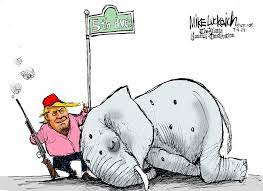
The two-party system has been a dominant feature of U.S. politics, almost from the beginning. George Washington, our first President, did not run for President on a Party ticket. George Washington was not elected by a popular vote in the way modern presidents are chosen. Instead, he was unanimously elected by the Electoral College. He is the only President who ever won with a unanimous vote of the electorate. Later, when different political parties formed, he was considered a member of the Federalist Party. The Federalist Party was one of the country’s first political parties. It was led by figures such as Alexander Hamilton and John Adams. The party favored a strong federal government and was supportive of the Constitution. The Federalists declined after the War of 1812 and eventually dissolved.
For as far back as I can remember, the major political parties have been the Democratic Party and the Republican Party. However, there have been third-party candidates representing other political viewpoints. In 2020, the Libertarian Party nominee for President was Jo Jorgensen. The Green Party candidate was Howie Hawkins. Don Blankenship was the candidate for the Constitution Party. None of these third-party candidates garnered any electoral votes, and they knew ahead of time that they wouldn’t, but they wanted to have a platform to express their views, and they did.
Many different political parties have come and gone over the years. The Whig Party emerged in the 1830s as an opposition to the policies of President Andrew Jackson. The party attracted a coalition of anti-Jackson forces, including former National Republicans and Anti-Masonic Party members. The Whigs were active in the mid-19th century but collapsed due to internal divisions over issues such as slavery.
The Know Nothing Party, also known as the American Party, gained prominence in the 1850s. It was characterized by nativism, anti-immigrant sentiment, and opposition to Catholicism. The Know Nothings were influential for a brief period but faded away due to the national focus shifting to the issue of slavery.
The Progressive Party (Bull Moose Party) formed by former President Theodore Roosevelt in 1912, was a short-lived third party. Roosevelt ran as its presidential candidate after losing the Republican nomination. The party advocated for progressive reforms, but it ultimately declined after the 1912 election.
The Dixiecrats (States’ Rights Democratic Party) formed in 1948 as a faction of Southern Democrats dissatisfied with the Democratic Party’s civil rights platform. Led by Strom Thurmond, the party opposed desegregation. While not a long-lasting party, it reflected regional discontent within the Democratic Party.
These parties played significant roles during their respective times but either disbanded or declined due to changing political landscapes, internal conflicts, or shifts in public opinion. The two major parties in the U.S., the Democrats and Republicans, have remained the dominant political forces for many years. Both parties have evolved over time, adapting to changes in the political and social landscape. The Democratic Party has a longer history, while the Republican Party emerged as a response to the sectional conflicts of the mid-19th century.
The Democratic Party is one of the oldest political parties in the world and has its roots in the Democratic-Republican Party formed in the 1790s in opposition to the Federalist Party. The Democratic-Republican Party, led by Thomas Jefferson and James Madison, advocated for states’ rights, agrarian interests, and strict interpretation of the Constitution. It eventually split into factions, with the followers of Andrew Jackson forming the Democratic Party. That party embraced the idea of popular democracy and expanded suffrage to a broader segment of the population. Jackson’s election in 1828 marked a turning point in the party’s history.
The Republican Party was founded in the mid-19th century in response to the contentious issues of the time and the expansion of the United States westward. Opposition to the spread of slavery into new territories was a key factor that led to the formation of the Republican Party. Activists, former Whigs, and anti-slavery Democrats came together to form a new political force. The Free Soil Party, active in the 1848 and 1852 elections, opposed the extension of slavery into the newly acquired territories, and many Free Soilers later joined the Republican Party. The Republican Party was officially founded on March 20, 1854, in Ripon, Wisconsin. The party’s first platform focused on opposition to the expansion of slavery and promoting industrialization.
The election of Abraham Lincoln, the Republican candidate, further solidified the Republican Party as a major political force. The election played a role in the secession of Southern states and the onset of the Civil War.
So, while it is difficult for us nowadays to picture any political parties other than the Democrats and the Republicans, there have been many many groups that have formed over the years, and now it seems that there is yet another one forming, the MAGA Party, led by Donald Trump. He has steadily siphoned off almost half of the Republican party, forming his new party, a party that wants to suspend the Constitution and give the President more power, similar to the authoritarian powers of Vladimir Putin in Russia, Kim Jong Un in North Korea, and Viktor Orban in Hungary. These powers would also include immunity from prosecution for any and all crimes committed by the President, including the assassination of his political rivals.
Is this the end of the Republican Party? Not likely. The current party leaders lack the guts to stand up to the Trump mob, and even Nikki Haley, who is running against him in the Republican primaries, has stated publicly that she will support him if he is the Republican Party’s nominee for President. Eventually, new, more courageous leaders will emerge, though, who will take back the ideals of the Grand Old Party, but that will first require a crushing defeat of the MAGA Party in the November election.
We need two strong political parties in this country. I feel that the liberal Democratic Party is the gas pedal that propels the country forward, and the conservative Republican Party is the brake pedal that keeps us from skidding out of control and running off the road. One, without the other, is not good for the country. So, I call upon all Democrats to help save the Grand Old Republican Party from the MAGA cancer that is killing it from within. Help restore sanity in government by solidly crushing the MAGA Party in November.
Peace & Love, and all of the above,
Earl

 earlthepearl137