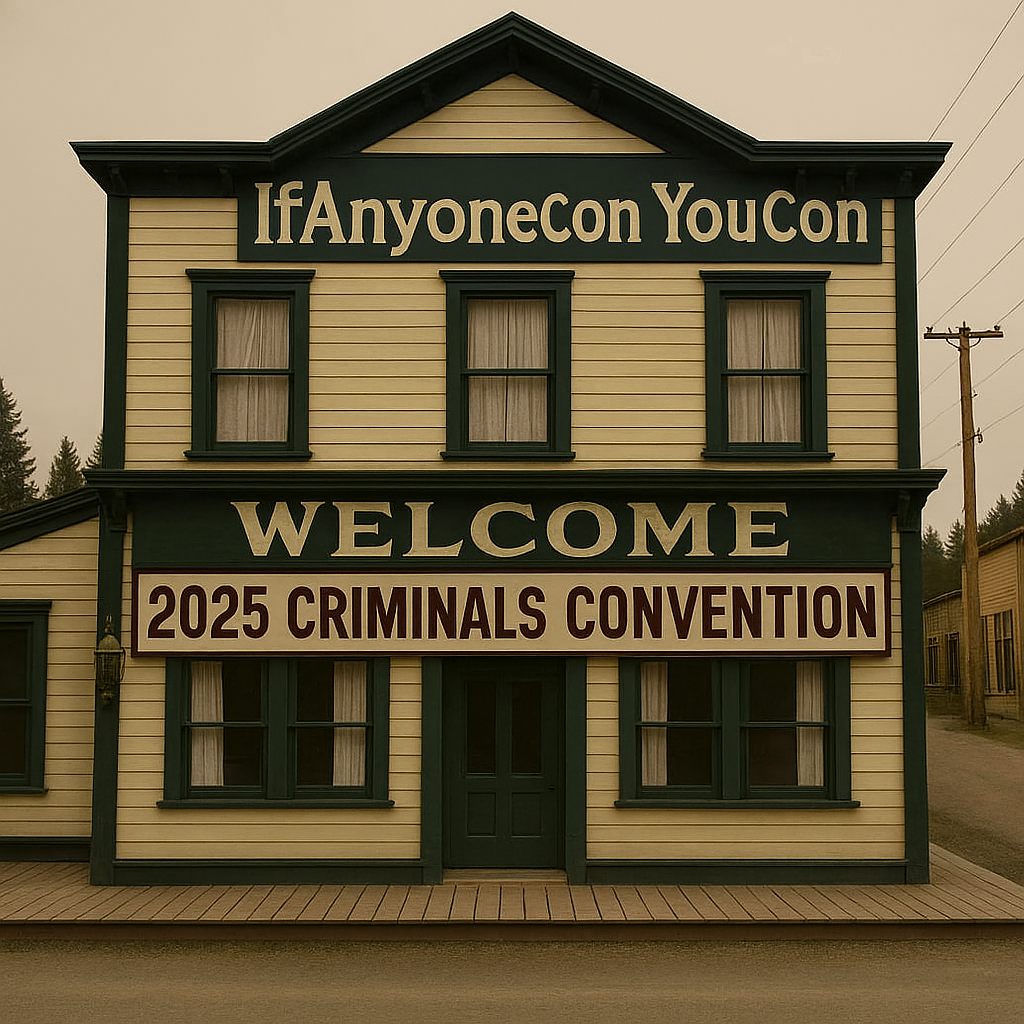
Wanted in 125 Countries, But Welcomed in Alaska

I almost got kicked out of a diner once for trying to order a Jim Beam milkshake with my breakfast. The waitress said it violated “company policy.” I said it violated my taste buds to drink anything without a little rebellion in it. We settled on a root beer float and a mutual understanding that rules are only flexible when the manager’s on break.

Which brings me to Alaska.

Whoever is running this country must be on a break. This Friday, two men—one a convicted felon, and one wanted in 125 countries for war crimes—will meet at a Hotel in Alaska to discuss peace, war, and possibly who gets custody of Crimea. Donald Trump, who is the only U.S. President with felony convictions, will host Vladimir Putin, a man wanted by the International Criminal Court for abducting Ukrainian children. He is wanted in 125 Countries, while Donald Trump is unwanted everywhere he goes.

Now, before you ask, “How is this legal?”—let me remind you: the United States isn’t part of the ICC. We opted out, presumably to keep our own war crimes tidy and domestic. So while 125 countries would slap cuffs on Putin faster than you can say “borscht,” Alaska rolls out the welcome mat. Probably one with a bear on it.

I imagine the summit will be held in a Bail and Breakfast place, with moose jerky appetizers and a ceremonial exchange of MAGA hats and Kremlin lapel pins. Trump will declare peace in our time, Putin will drink Vodka and nod solemnly, and somewhere in The Hague, a judge will throw a gavel at the wall.  Or maybe one of Putin’s political opponents will vigorously protest by “accidentally” throwing himself off a 30th-floor balcony.

This is not diplomacy. It’s dinner theater.

And yet, there’s something heartbreakingly American about it. We love a good outlaw. Jesse James. Al Capone. Butch Cassidy and the Sundance Kid, not to mention the guy who invented the McRib. We don’t mind criminality as long as it comes with a slogan and a side of fries. Trump and Putin are just the latest duo in our long tradition of “bad boys with branding.”

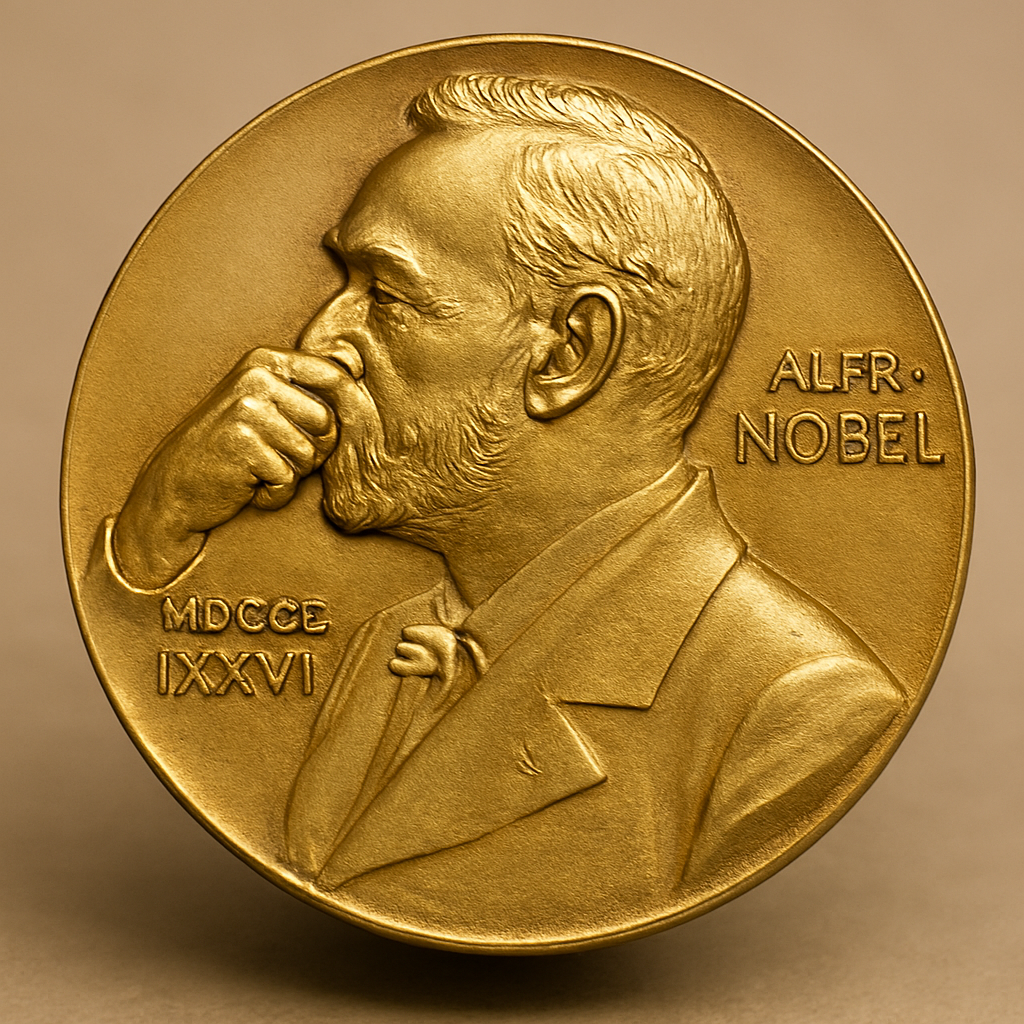
But here’s the rub: this isn’t a sitcom. It’s real. Ukraine is bleeding. Children have been taken. Democracy is being bartered like a used snowmobile. And while the rest of the world tightens its grip on justice, we’re hosting a summit meeting between two known criminals.  The only result anyone expects is for Putin and Trump to issue a joint nomination for the Nobel Peace Prize—submitted in black Sharpie and sealed with a vodka stain.
Peace & Love, and all of the above,

Earl
We Will Bury You

For those of you, too young to remember this.  On November 18, 1956, during a reception at the Polish Embassy in Moscow, Soviet Premier Nikita Khrushchev addressed Western diplomats amidst the tense atmosphere of the Cold War. The world was still reeling from the aftermath of World War II, and the ideological struggle between capitalism and communism was at its peak.

Khrushchev, known for his fiery rhetoric and bold proclamations, declared:

> “Мы вас похороним!” > (Pronounced: “My vas pokhoronim!”)

Translated literally, this means “We will bury you!” The statement sent shockwaves through Western nations, intensifying fears of Soviet aggression and the potential for nuclear conflict. We started building bomb shelters and holding air-raid drills.

The phrase, however, was a subject of misinterpretation due to cultural and linguistic differences. In Russian, the expression is a common idiom akin to saying “We will outlast you” or “We will be present at your funeral.” It’s not necessarily a direct threat of violence but rather a prediction of the eventual triumph of one system over another.

Khrushchev later clarified his remarks, stating:

> “I once said, ‘We will bury you,’ and I got into trouble. Of course, we will not bury you with a shovel. Your own working class will bury you.”

This reflects the Marxist belief in the inevitable collapse of capitalism due to its internal contradictions, leading to a proletarian revolution.

Khrushchev was a complex figure. He criticized Stalin’s brutal regime and introduced reforms to reduce oppression.  He launched the Virgin Lands Campaign to boost food production. Under his leadership, the USSR launched Sputnik, the first artificial satellite, marking a significant achievement and initiating the space race with the United States.

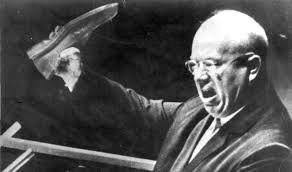
Yet, his approach to diplomacy was often unorthodox.  In 1960, he banged his shoe on a desk at the United Nations to emphasize a point.  His decision to place nuclear missiles in Cuba led to a critical standoff with the United States in 1962, known as the Cuban Missile Crisis.

In November of 1956, Krushchev predicted that Russia would outlast the United States, because our people would overthrow our government.  In November of 2024, 75 million Americans did just that when they elected Donald Trump, a pro-Russian Putin puppet, as President.  Today, in the same U.N. building where Krushchev once banged his shoe on a desk to protest a U.N. decision, the United States turned its back on Ukraine and voted with Russia on a U.N. proposal.  It took almost 7 decades for Krushchev’s prediction to come true, but our own working class has finally buried us. I just hope we can dig ourselves out.

Peace & Love, and all of the above,

Earl