Posts

Remembering John

I haven’t written a blog since my best friend John passed away a few weeks ago. It’s hard to find the right words when the silence left behind feels louder than anything I could write.  I always considered John to be my best friend, and I tried to be his best friend. There was plenty of competition, though—he treated all his friends as best friends.  That was John. He didn’t ration affection. He didn’t play favorites. He made you feel like the center of the room, even when the room was full. And somehow, you believed it—because with John, it was true.

John lived in Long Beach, Long Island with his wife Margaret.  In a twist worthy of a song lyric, he met his wife Margaret one night while we were out celebrating my birthday.  They raised three remarkable children—Eileen, Andrea, and Johnny—each carrying forward a piece of his spirit. Eileen, who illustrated my children’s book, lives upstate with her husband Christopher and their two children, Jack and Nora. Andrea is a scientist, married to Mark, and together they’re devoted Phish fans. Johnny works behind the scenes on television stages and at Lincoln Center, a quiet craftsman in the world of performance.

John and I met in 1971 at the N.Y. Telephone Co. We bonded over music, mischief, and the kind of friendship that doesn’t need explaining. We played on the same Telephone Company softball team, The Newtown Suns.  He loved Family and Friends, Baseball, Music, and Long Beach.  One year, Eileen gave him a birthday gift that lit him up—a guest DJ spot on a radio station in Woodstock, NY. That was one of his best days. He was in his element, spinning tracks and stories like he’d been born for it.

We had plenty of great times together. I went to all his parties, and after I moved to Lancaster, he came out here a few times a year to cheer on the Lancaster Barnstormers with me.

I have dozens of CDs he made for me.  I can listen to them and think about him, but nothing can replace him.  John loved Baseball, especially the Yankees.  So, now that he joins Willie, Mickey, and the Duke in a Field of Dreams somewhere, I’ll play this song for him.

Willie, Mickey, and the Duke (Talkin’ Baseball)

 He was just a very special person.   I was lucky enough to know him and party with him for more than 50 years.

Peace & Love, and all of the above,

Earl
No Kings, the Rally Heard ’round the World

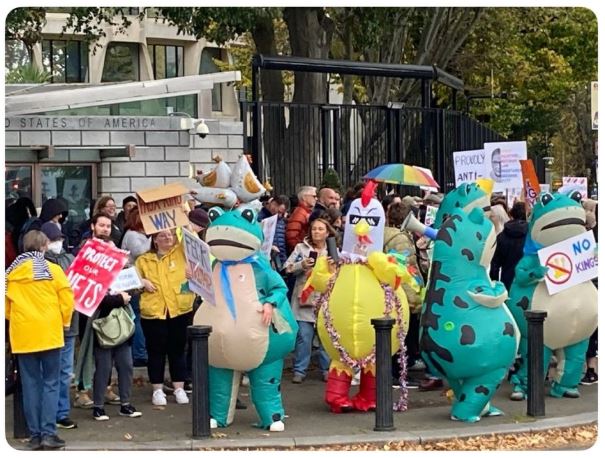
Yesterday’s No Kings Rally wasn’t just a protest — it was a reckoning. A mosaic of causes, signs, and voices, all bound together by one unifying thread: We the People have been stirred to action. Not by policy differences. Not by party loyalty. But by the cruelty, the malignant narcissism, and the corrosive influence of Donald Trump.

Fascism began as a Roman metaphor: a bundle of sticks (fasces) symbolizing strength through unity. One stick breaks easily. A bundle resists. Mussolini twisted that into authoritarianism. Hitler weaponized it. And Trump? He tried to make the bundle serve only him — demanding loyalty, punishing dissent, and mocking the vulnerable.

But yesterday, we reclaimed the bundle. Not as a tool of domination, but as a symbol of democratic resistance. Many years ago, Chief Tecumseh taught the same lesson with arrows. The Founders echoed it with E Pluribus Unum. And yesterday, the signs told the story.

The signs and speeches were about:

  • Protecting reproductive freedom
  • Defending LGBTQ+ rights
  • Expanding healthcare access
  • Preserving Social Security and Medicare
  • Combating climate change
  • Supporting veterans and mental health
  • Raising wages and strengthening unions
  • Reforming immigration and criminal justice
  • Fighting voter suppression and gun violence

These weren’t isolated chants. They were verses in a shared anthem: We the People demand better. And we demand it together — because cruelty in power has a way of clarifying what really matters.

And then came the sign that stopped me cold: “They’re eating the Epstein files.”

It wasn’t just funny. It was surgical. A jab at the elite’s appetite for secrecy, distraction, and self-preservation. As the files trickle out, the public appetite for truth grows — and so does the suspicion that someone’s chewing through the evidence.

This wasn’t a rally of factions. It was a rally of fusion. The bundle is back — not in the hands of tyrants, but in the grip of citizens. We’re demanding accountability from Government, and we’re doing it together.

So next time someone asks what the rally was about, tell them this: It was about E Pluribus Unum. It was about We the People. It was about refusing to be ruled by cruel tyrants ever again.

Be there for the next rally.  Courage is contagious.

Peace & Love and all of the above,

Earl

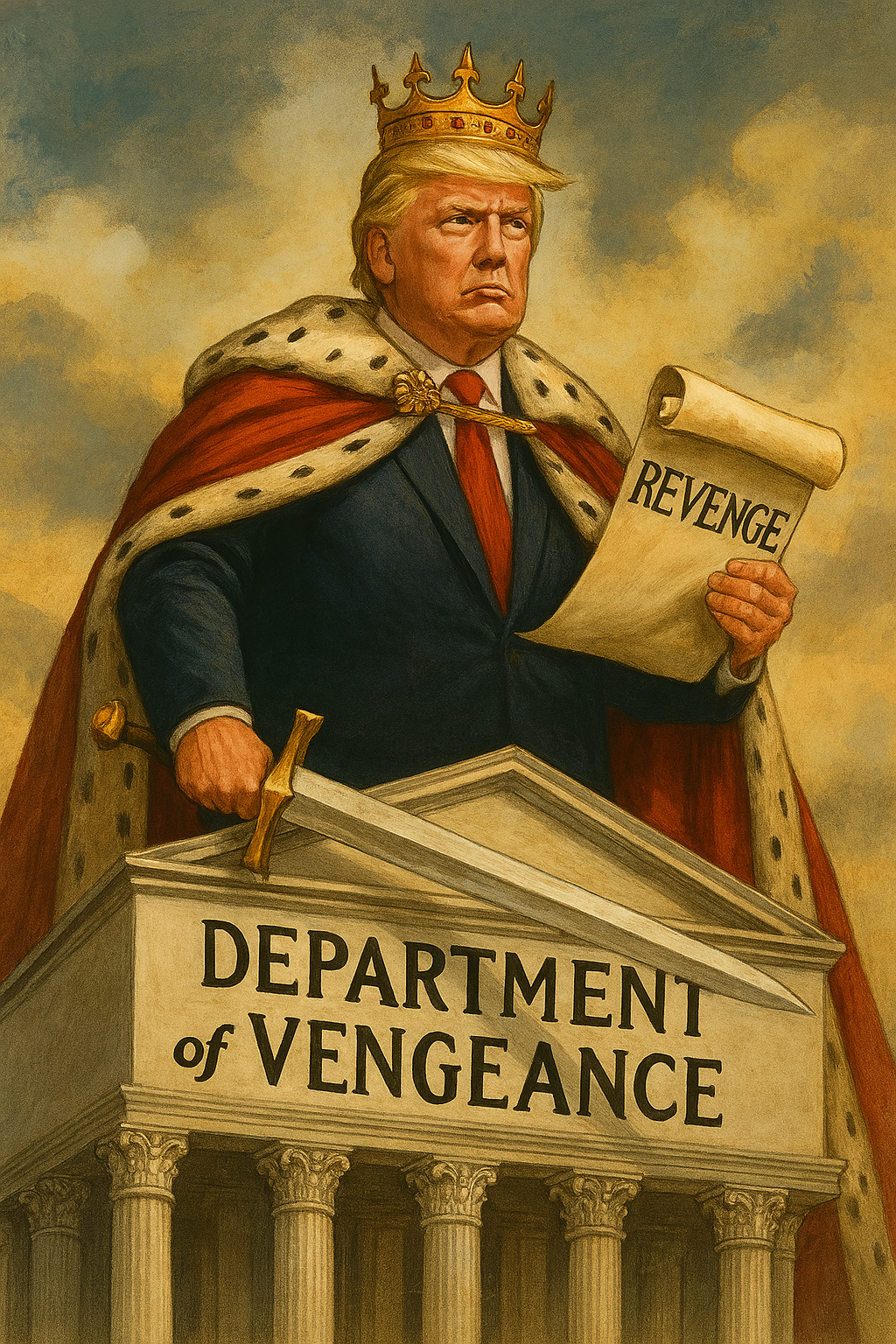
The Department of Vengeance

As America prepares for the No Kings Rally — a celebration of democratic resistance and constitutional humility — it’s worth asking: what kind of kingdom are we resisting?

Recent headlines suggest we’re not just dealing with a president. We’re dealing with a monarch-in-waiting, armed not with a crown, but with a blacklist.

He’s already renamed the Department of Defense the Department of War — now he’s eyeing the Department of Justice for a makeover: the Department of Vengeance.

Donald Trump has made no secret of his desire to punish his political enemies. He’s called himself “your retribution”. He’s floated criminal referrals for Letitia James, who dared to hold him accountable for civil fraud. He’s targeted James Comey and John Bolton, not for crimes, but for defiance. And he’s done it all while testing the waters of public appetite for vengeance — a campaign strategy that doubles as a loyalty test.

This isn’t justice. It’s grievance cosplay.

The so-called Department of Vengeance isn’t a real agency, but it might as well be. Trump’s allies have proposed purges of federal institutions, loyalty oaths for civil servants, and even a new “Department of Government Efficiency” — a euphemism for gutting agencies that don’t kiss the ring.

Let’s be clear: this is not about restoring order.  It’s about rewriting the rules so that dissent becomes disloyalty, and accountability becomes treason.

And yet, the system resists. Grand juries refuse to indict political targets. Judges push back. Juries — those pesky peers — still ask for evidence, not vendettas. The machinery of democracy may be creaky, but it hasn’t collapsed.  Journalists, too, are standing up.  They walked out of the Pentagon after they refused to sign agreements that they would only write approved stories.

So, as we gather for the No Kings Rally, let’s remember: the crown isn’t just a metaphor. It’s a warning. When a leader builds a Department of Vengeance, he’s not just settling scores. He’s auditioning for tyranny.  Trump is a wannabe Fascist, but like John Bolton once said, “To be a fascist, you have to have a philosophy. Trump’s not capable of that. You know, Adolf Hitler wrote a profoundly troubling book called Mein KampfMy Struggle. Donald Trump couldn’t even read his way all the way through that book, let alone write something like it.”

Nonetheless, Dumb Donnie wants his revenge fantasies. We just want to keep our republic.  Join the rally and help us.

Peace & Love, and all of the above,

Earl

Is There Baseball in Heaven?

First we’ll use Spahn, Then we’ll use Sain, Then an off day, Followed by rain. Back will come Spahn, Followed by Sain and followed, we hope, By two days of rain.

That was the Braves’ pitching strategy back in 1948, the year I was born. It was a poetic plan built on two arms and meteorological optimism. It didn’t quite deliver a World Series win, but it gave us one of baseball’s most enduring mantras: trust your aces, pray for rain, and hope the schedule cooperates.

Fast forward to today’s playoffs, and the prayers haven’t stopped — they still go skyward. Every time a slugger hits a home run, he points to the Heavens like he’s communicating with the great batting coach in the sky. The gesture is so common it’s practically part of the batting stance.

And yet…

If God is the Creator of the Universe — galaxies, black holes, cosmic radiation, and the occasional rogue asteroid — is He really tuning in for Game 3 of the ALDS?

The idea that God has a “chosen team” is about as plausible as the Earth being flat. And yet, every October, we get a parade of skyward glances, post-game interviews thanking Jesus for the walk-off double, and fans convinced that their prayers tipped the ump’s call.

So, this playoff season, point to the sky if you must — just know that you may be interrupting a divine Zoom call between God and the Andromeda High Council, where they might be experiencing a severe plumbing problem.

If you’re wondering whether God’s rooting for your team, just check the scoreboard. If you’ve got two starters like Spahn and Sain, and it says “Rain Delay,” that could be your answer.

Peace & Love, and all of the above,

Earl

Don’t Believe Me, Just Watch

Joseph Goebbels, Hitler’s Minister of Propaganda, is most often associated with the quote: “If you repeat a lie often enough, people will believe it, and you will even come to believe it yourself.”  Goebbels’ propaganda strategy was repetition, emotional appeal, and the manipulation of public perception.

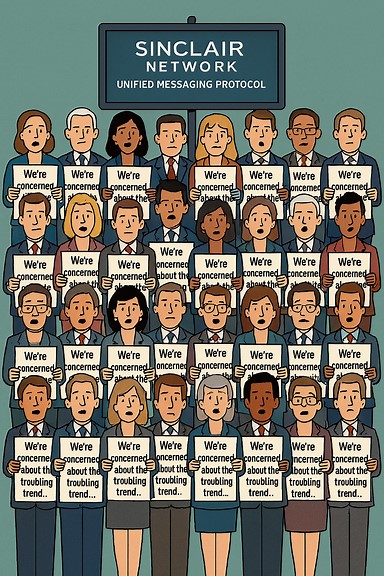
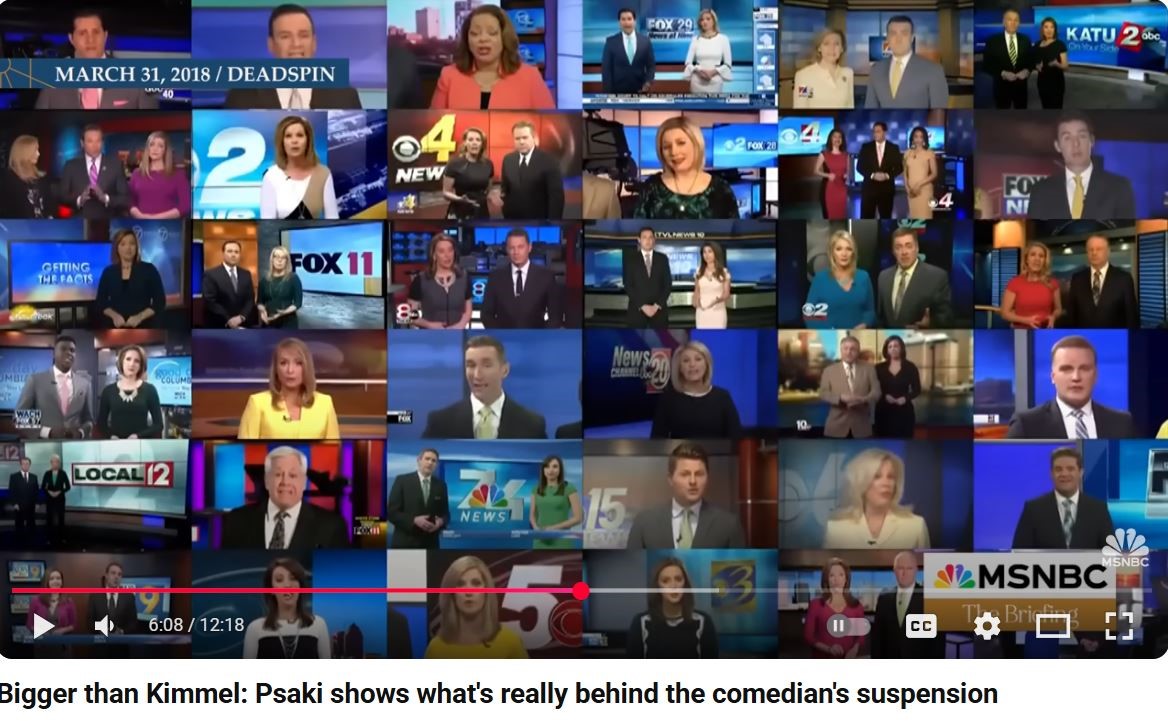
Jen Psaki recently aired a chilling montage: 36 Sinclair-affiliated newscasters in 36 different cities reciting the same exact script, word for word. It wasn’t a blooper reel—it was a broadcast strategy to “flood the zone” with their message.  “If you repeat a lie often enough, people will believe it.”   Ironically, their message was “We’re concerned about the troubling trend of false news…” Obviously, the irony was lost on them.  What are the odds that 36 different opinion influencers in 36 different cities all had the very same word-for-word opinion about a current problem?  You have better odds of hitting the Powerball Grand Prize. When 36 newscasters in 36 different cities say the same exact thing, it’s not journalism—it’s choreography.

This isn’t just lazy journalism. It’s tactical repetition—a propaganda technique.  Joseph Goebbels believed that if you repeat a lie often enough, it becomes truth, not through evidence, but through echo.  The modern Republican messaging follows this blueprint with eerie precision. When a false claim emerges—whether about elections, vaccines, or climate—it’s not debated. It’s deployed. Within hours, the same phrases surface across Fox News, congressional tweets, and local radio. It’s not persuasion. It’s programming.  This isn’t about disagreement. It’s about manufactured consensus. The goal isn’t to win an argument—it’s to flood the zone with noise until truth becomes indistinguishable from fiction.

  • It starts with Centralized Messaging: GOP operatives distribute talking points like marching orders. The purpose is Repetition Over Reason: The same phrases—“weaponized DOJ,” “rigged election,” “woke indoctrination”—are repeated ad nauseam.  Then comes the Emotional Anchoring: Lies are tied to fear, patriotism, or outrage, bypassing logic and triggering tribal loyalty.  The final step is to Flood the Zone. Currently, the Republicans are blaming the government shutdown on Democrats. Not with nuance, not with evidence, but with a synchronized chant: “Democrats are shutting down the government to give billions in healthcare to illegal aliens.” It’s an outrageous lie. A loud, coordinated, cynical lie. But it’s everywhere—on cable news, in press releases, across social media. The goal isn’t persuasion. It’s saturation. “If you repeat a lie often enough, people will believe it, and you will even come to believe it yourself.” 

This isn’t new. But the scale, speed, and shamelessness of its practitioners are unprecedented.

When truth becomes optional, democracy becomes ornamental. Plato warned that unchecked rhetoric leads to tyranny. Goebbels promoted it. And today’s Republican echo chamber is actually proving that it works in real time.  They were able to get a twice impeached, convicted rapist and felon elected to the highest office by spreading lies without caring if they were true or not, “They’re eating the dogs!”

We don’t need censorship. We need media literacy, moral clarity, and the courage to call the repetition of lies what it really is: a weapon.

“Don’t believe me, just watch.”

Bigger than Kimmel: Psaki shows what’s really behind the comedian’s suspension

If you don’t want to hear the entire story, fast forward 5 minutes into the video to get to the reveal.

If you’re disappointed that this post was all about Propaganda instead of Bruno Mars, I included the Bruno Mars video to make you feel better.

Mark Ronson – Uptown Funk (Official Video) ft. Bruno Mars

Peace & Love, and all of the above,

Earl

Myths

Educated people don’t believe in unicorns. Or mermaids. Or Atlantis, Bigfoot, or the Fountain of Youth. These are dismissed as charming myths—cultural artifacts with no empirical backing. And rightly so. We’ve combed the forests, dredged the lakes, and carbon-dated the ruins. No horned horses. No fish-women. No golden cities.

But God? That’s different.

Despite the same lack of physical evidence, belief in God is not only accepted—it’s revered. Taught in schools, sworn on in courtrooms, and invoked in campaign speeches. The same minds that scoff at fairy tales will defend divine presence with philosophical rigor and moral urgency.

This isn’t a jab at faith—it’s a spotlight on the intellectual gymnastics required to hold both positions. The educated skeptic who demands peer-reviewed proof for mythical beasts will often grant God a pass. “It’s about faith,” they say. “Transcendence. Meaning.”

But why does God get the exemption? Why not the unicorn, who at least has the decency to sparkle?

Maybe it’s not about evidence at all. Maybe it’s about utility. God offers moral scaffolding, community, and cosmic comfort. Unicorns offer glitter and horn-based combat. One gets a cathedral; the other gets a Lisa Frank folder.

So, we believe what serves us. Not what’s proven. And maybe that’s the real myth: that educated people believe only what’s true.

This isn’t a call to abandon belief. It’s a call to examine it. To ask why some unproven ideas are cherished while others are ridiculed. To recognize that even the most rational minds are shaped by culture, emotion, and need.

And if we’re going to believe in things unseen, maybe we should give the unicorn a second chance. At least she never started a war.

Peace & Love, and all of the above,

Earl
How I Solved Every Problem in My Life Using the Internet (And a Spoonful of Salt)

Let me tell you something: I used to be a man plagued by problems. Swollen ankles, dry skin, existential dread, and a rollator that squeaked like a haunted shopping cart. But then I discovered the Internet. Not the useful parts—no, no. I dove headfirst into the shimmering swamp of clickbait wellness hacks. And I emerged reborn. Possibly radioactive.

It started innocently. A headline whispered: “Dermatologists Hate Her: She Mixed Salt and Vaseline and You Won’t Believe What Happened Next.” I clicked. I believed.

I smeared the concoction on my elbows, my knees, and—at one point—my neighbor’s cat (long story, restraining order pending). My skin glowed. My pores sang. I became the unofficial exfoliation guru of Lancaster, PA.

Next came the swelling. My ankles looked like they were storing winter grain. But the Internet had my back: “Doctors Beg You to Try This One Trick Before Bed!”

It involved pressing a mystery pressure point behind my knee while chanting the phrase “Water be gone!” in Latin. I don’t speak Latin, so I used Pig Latin. It worked. Or maybe I just stopped eating pretzels. Either way, I now float like a butterfly and retain water like a sieve.

Then came the most sacred of promises: “Men Over 70 Are Raving About This Root That Restores Vitality!” I clicked. I raved. I rooted.

The cure involved a Peruvian tuber, a Himalayan breathing technique, and a YouTube video narrated by a man named “Dr. Randy.” I followed every step. My blood pressure rose. So did my eyebrows. Did it work? Let’s just say I now walk through the parking lot with a confident swagger and a strategically placed fanny pack.

The Internet has solved all my problems. I no longer trust doctors, pharmacists, or anyone with a stethoscope who doesn’t also sell supplements on YouTube. Why? Because the Internet taught me that Tylenol causes autism—a theory endorsed by two of America’s loudest unlicensed pediatricians: Donald Trump and RFK Jr.

Now, I don’t know if that’s true. I do know that after reading seventeen blog posts and watching a video narrated by a man named “Quantum Dave,” I threw out all my acetaminophen and replaced it with Himalayan salt, raw honey, and a crystal shaped like Joe Rogan’s bicep.

My ankles still swell, my skin still flakes, and my rollator still squeaks—but my mind is free. Free to believe that Big Pharma is hiding the cure for everything in a jar of Vaseline and a Peruvian root. Free to chant “Water be gone!” while pressing my knee and waiting for enlightenment. Free to click “Next Page” until I forget what I was looking for.

Next week, I’ll be trying the “Cabbage in Your Sock” method for memory enhancement and the “Toothpaste on Your Eyelids” trick for lucid dreaming. Stay tuned. Or don’t. I’ll be glowing either way.

Peace & Love, and all of the above,

Earl

Candygram for Earlthepearl137

It happened just after dusk. I was halfway through reheating last night’s chili when the knock came — firm, rhythmic, and suspiciously polite. I figured it was U.P.S. with my Bourbon order. I opened the door to find two masked men, dressed like extras from a dystopian reboot of The Blues Brothers, holding a ribboned box and wearing jackets labeled “I.C.E.”

“Candygram for Earlthepearl137,” one of them said, eyes wide with bureaucratic innocence.

I blinked.  I wasn’t surprised — I’d just published a blog post titled The End of Free Speech: A Love Letter to Monitored Comedy.  I knew the drill. Say something morally clear, challenge selective outrage, and suddenly you’re on the compliance radar.  Satire, when done right, makes some people nervous.

In my latest post, I questioned the double standards of speech policing — how moral clarity gets labeled “aggressive,” while actual harm gets a pass if it’s wrapped in patriotism or profit. I used examples from club signage, media pivots, and the way certain phrases get flagged not for content, but for who’s saying them.

Apparently, that was enough to trigger a “courtesy check.”

The I.C.E. agents didn’t arrest me, though. They didn’t even enter. They just stood there, box in hand, waiting for me to acknowledge the delivery. It was performance art — a compliance ritual dressed as concern. And like all good satire, it left me wondering: who’s really afraid of free speech?

I reached for the candygram, and the masked man winked. Not a friendly wink. The kind that says, We know where you live.

And then I woke up.

I wonder if it was a dream or a premonition.

“No Kings Day” – October 18th. Be there and bring a friend.

Peace & Love, and all of the above,

Earl
He Who Laughs Last

The last working bulb on the stage at the Chuckle Bucket flickered like it knew a punchline was coming.  Marty’s set was one of the few that still had punchlines.  The other comedians just did their 7-minute sets by conversing with the sparse audience, asking them about their problems.  It wasn’t funny, but it made the handful of people in the room at least feel heard, and, in reality, that was probably what they came for.  The comedy clubs were all closing ever since Trump signed an executive order that the government had to approve all jokes.

Marty still told jokes.  But he was very careful about how he phrased them.  “I want you to know that I love this President,” he said,  “I really, really love him.  I love him so much I named my ulcer after him.”

The crowd chuckled, cautiously. A laminated sign on each table read: “Please laugh responsibly.”  Even the regulars, the ones who dropped in more than once a week, didn’t know what to make of that sign.  Was it a joke?  Or was it serious?  Several times when a joke landed perfectly, a person passing by the club might be able to hear laughter coming from within.  It might make them curious, but they dared not go inside.  On the respectability scale, Comedy clubs were ranked somewhere between pornographic theaters and whore houses.

Marty riffed on the new Federal regulations, that he said had just come out that morning:

  • No impersonations can be performed unless pre-approved by the Bureau of Comedy, unless, of course, you were making fun of Democrats.  Those got exceptions, except for impersonators who did Biden.  It seems that too many impersonators, when they were questioned by the comedy police for doing bits where they acted like a stupid, senile old man, would just swear that they weren’t making fun of the current President.  They argued that they were doing Biden.  To put a stop to that defense, all Biden impersonators were henceforth outlawed.
  • No satire was allowed unless it was accompanied by a disclaimer that it was created using AI.”

Marty leaned into the absurdity:

“I tried to do a bit once about my uncle’s conspiracy theories. My act got flagged for ‘unauthorized nostalgia.’  My license to be a comedian was revoked for six months.  It was terrible, a life without comedy.  I felt like I was in Alabama.”

The audience winced. They hoped that no Republican politician from Alabama would ever hear that joke.  They didn’t want Marty to mysteriously disappear like so many other comedians had.

Marty moved on.  “I had a dream about the President this week.  I went to my therapist and asked her if that was normal.  She asked me if I woke up screaming.  I said yes, and she said, Don’t worry about it, then.  That’s normal.” 

The four people in the audience laughed nervously.

“Don’t worry, folks. I’ve got my Passport ready.”

He looked offstage for a second.  “Well, that’s my time.”  He closed with the line that had become his signature—less a joke, more a eulogy:

“And remember, he who laughs Last… turns out the lights.”

He threw the switch that shut off the electricity to the one lightbulb that lit the stage, and he walked towards the bar.  The four people in the room stood up, not in ovation, but in quiet recognition. Marty wasn’t just a local comic. He was the custodian of what used to be funny.

Peace & Love, and all of the above,

Earl

The Rules of the Road

I went to my Aunt Miriam’s funeral in Ohio last week.  Naturally, it was a sad occasion, but it still had it’s lighter moments.  That’s one of the benefits of the deceased being 91 and someone who we knew had lived a full life.  My Aunt survived my Uncle George by 5 years, but in her final months she was losing her memory and fading quickly.  So, while it is always sad to lose someone, it wasn’t a big surprise when she passed.  So, the funeral, while solemn, felt more like a family reunion, only with less alcohol.

Decades ago, I realized that drinking and driving was a very dangerous combination, so, putting safety first, I gave up driving.  Luckily for me, my brother Donald was driving to the funeral from his residence on Long Island, New York, and he agreed to stop in Lancaster on Sunday to pick me up.  He even showed up with breakfast.  What a good brother.

Most people just use GPS to get to their destination. My brother Donald also drives with a set of self-imposed rules.  He likes order, predictability, and structure. I’m more loosey goosey.  So, our road trip was a study in contrasts. He had everything planned out.  I was in road trip mode, just ready to see what the road had in store for us.  Donald’s girlfriend, Kathleen wanted to attend the service, but she had to work on Sunday.  They worked out a plan.  Donald would drive to Akron.  When she got off work, Kathleen, ever the jet-setter, would fly to Akron with a short layover in Washington, D.C.  Donald would pick her up at the Akron airport.

We got to Akron around 5 p.m. and Kathleen’s flight wouldn’t arrive until 9 p.m.  I suggested we go to the hotel bar, where we could grab something to eat and watch football.  Don agreed, but because he had to drive to the airport at 8:30 he would only have one drink.  I, once again, thanked my lucky stars that I had made the right decision decades ago to quit driving, so I didn’t have to stop at just one drink.  “Kathleen likes the room to be cool,” Don said.  So, we cranked up the a/c before we headed to the bar. I’m not a big fan of air conditioning, but I knew that I would be able to stock up on “anti-freeze” at the bar, so I readily agreed to pre-chilling the room for her.  Donald let me continue watching football when he went to pick up Kathleen.  We entered the room, and I felt like I had walked into Superman’s Fortress of Solitude in the Arctic Circle.  Donald showed no reaction.  Kathleen loved it.  I put a jacket on and asked if we were expecting a family of penguins to drop by for a visit.  I remembered that Donald and Kathleen met while both of them were on vacation in Iceland in January of 2024.  Iceland in January. She must really love the cold.  I wondered if she might be part polar bear.  Anyway, we turned in early and I slept well under a thick layer of sheets, blankets, and bedspreads. 

We got up early, had breakfast, and headed off to the funeral.  There we met all our Ohio cousins.  The wake was held in the entrance of the church.  After an hour, everyone moved into the church for the funeral mass.  I found a spot close to an exit, just in case the walls couldn’t withstand my Atheistic vibrations.  After the service, we all went across the street for a funeral luncheon, and then it was time to get back on the road home. 

On the return trip, Donald drove the first 60 miles and made two wrong turns because the GPS wasn’t prepared for the Ohio traffic circles.  We all laughed the first time, when the GPS immediately responded with, “Make the first U-turn.”  After we came out of the wrong section of the next traffic circle, however, only Kathleen and I laughed when the GPS again responded with “Make the first U-turn.” We teased Donald.  One of his rules of the road is don’t poke the driver, and we were both poking him quite a bit, when he responded with something that upset Kathleen. I suggested he apologize. Instead, he executed a silent transfer of power: He stopped the car, climbed into the back seat, and handed her the keys.  He was trying hard to give us the silent treatment, but Kathleen and I just began singing along to the oldies on the radio, and we used some serendipitous lyrics to lob good-natured jabs at Donald, “Come on you people now.  Smile on your BROTHER.  Everybody get together.  Got to love one another right now.”

Another of Donald’s rules on a road trip is that we stop every two hours for a restroom break.

Kathleen was driving, and we were approaching one of the rest areas, which are spaced about 40 miles apart on the Turnpike.  This was supposed to be our scheduled stop.  Kathleen, looked at me and quietly asked me if I had to go to the bathroom.  I shook my head “No.”  “You?” I asked.  She shook her head, no.

“Ooops! I missed the entrance ramp for the rest stop,” she said as we cruised by the rest station.  Donald had to hold his water for 40 more miles.  The power had shifted, and that ended the silent treatment.  Peace was quickly restored.  We pulled into the next rest stop, and everyone was relieved in more ways than just number one.  We got back in the car, and all three of us were now singing along to every song on the radio, even when we went through tunnels and the satellite radio cut out.  We were back in perfect harmony, even if we might have sounded more like the Karaoke crew from hell.  The next thing you know, we were in Lancaster, and we stopped at a diner to get something to eat, and laugh about “what a long, strange trip it was.”

This trip had rules, yes. But it also had rhythm. And quite a bit of laughter. It had the kind of shared absurdity that turns a trip into a fond memory. Donald may live by rules, but Kathleen and I didn’t always follow them—and together, that made the road a little warmer. Even when the AC said otherwise.

Peace & Love, and all of the above,

Earl