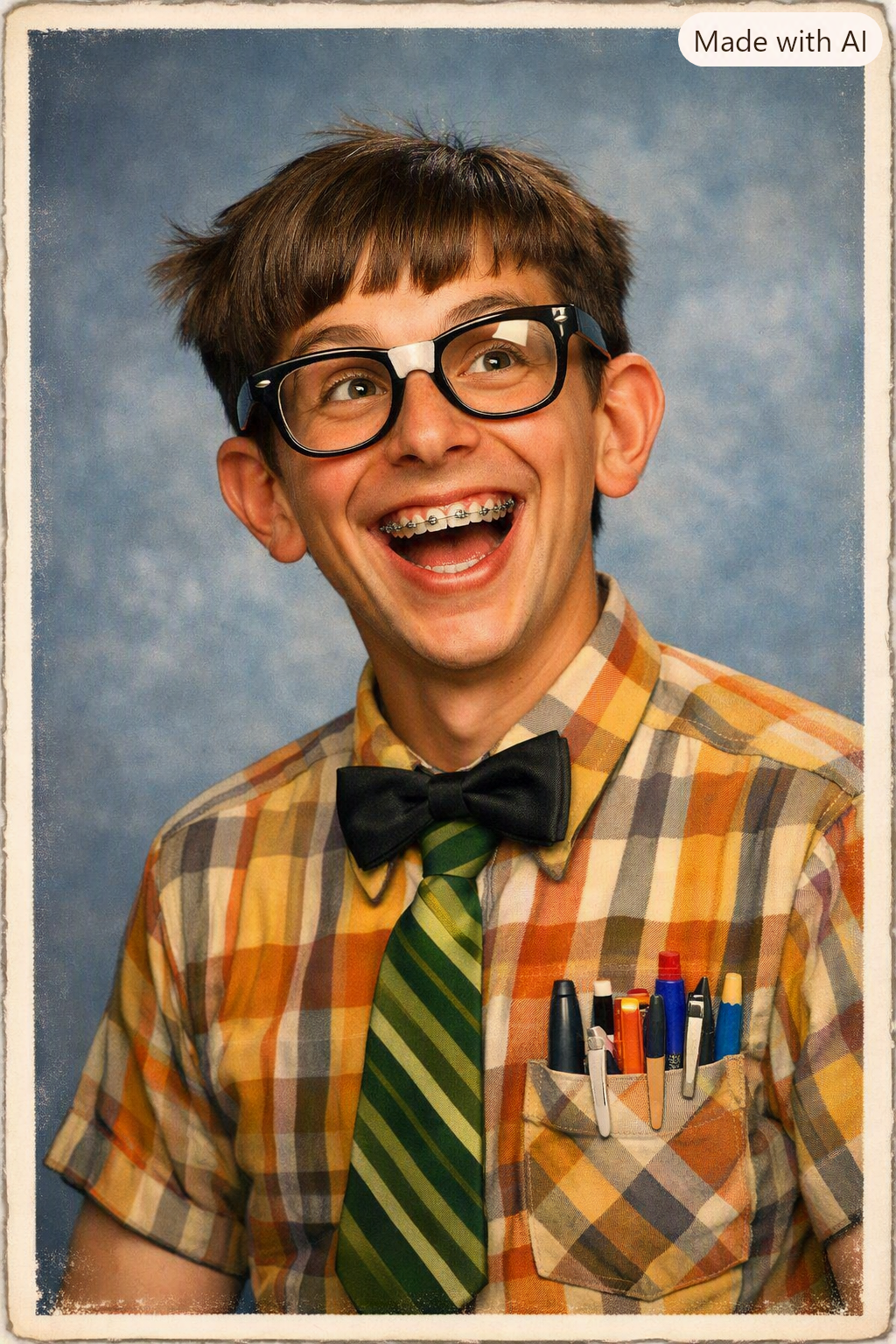
Exit Velocity


I got an e-mail from my high school alumni association asking me to submit an article on where my life has gone since High School. Here’s what I submitted.

Escape Velocity — How I Survived Catholic School and Became a Proud Atheist
I spent thirteen years in Catholic school — thirteen years of uniforms, catechism, and guilt as a second language. If you ever wondered what it’s like to grow up under constant moral surveillance, imagine being told that God is watching you and Brother Luke Martin has binoculars.
So when Christ the King high school asked alumni to write about “where we are today,” I thought: Spiritually? I’m off-campus, way off campus.
My family’s devotion was inherited, not chosen — like a family heirloom you’re expected to wear even if it clashes with your outfit. Faith was comforting, sure, but also confining. Certainty has a way of wrapping around you like a warm blanket that slowly turns into shrink-wrap.
We were taught that doubt was dangerous. I later realized doubt is just healthy curiosity.
My escape wasn’t dramatic — no lightning bolts, no slammed doors. It was more like discovering that “critical thinking” wasn’t a sin after all. I realized the universe didn’t need a hall monitor.
I remember the first time I said aloud, “I don’t believe in God.” I braced for thunder, lightning, or at least a pop quiz from God. Nothing happened. The world kept spinning. That’s when I knew I’d achieved escape velocity.
Leaving faith behind was gradual, not rebellious. I didn’t trade hymns for heavy metal or start wearing black. I just stopped outsourcing my conscience. Curiosity replaced doctrine, and morality stopped being a checklist as I journeyed from Agnosticism to full-blown Atheism.
Turns out, you can be kind, honest, and decent without divine supervision — though you do lose access to guilt as a motivational tool.
Atheism didn’t erase morality; it clarified it. I learned that empathy doesn’t need commandments, and reason doesn’t need miracles. My ethics now come from people, not ancient parchments.
And honestly, life’s simpler when you don’t have to explain why an omniscient being needs weekly reminders that you’re sorry.
Catholic guilt, though — that’s the souvenir that never fades. It’s like a spiritual tattoo: invisible, indelible, and occasionally itchy.
To the students still navigating those hallowed halls of a Catholic high school: think freely, question deeply, and define belief for yourself. Faith, doubt, and reason aren’t enemies — they’re just different ways of asking the same question.
And if this essay somehow gets printed in the alumni newsletter, I’ll consider it my first miracle.
Sincerely,
Harold Earl Paulson, Class of 1966.

I haven’t heard back from them, yet.

Peace & Love, and all of the above,

Earl

Is There Baseball in Heaven?

First we’ll use Spahn, Then we’ll use Sain, Then an off day, Followed by rain. Back will come Spahn, Followed by Sain and followed, we hope, By two days of rain.

That was the Braves’ pitching strategy back in 1948, the year I was born. It was a poetic plan built on two arms and meteorological optimism. It didn’t quite deliver a World Series win, but it gave us one of baseball’s most enduring mantras: trust your aces, pray for rain, and hope the schedule cooperates.

Fast forward to today’s playoffs, and the prayers haven’t stopped — they still go skyward. Every time a slugger hits a home run, he points to the Heavens like he’s communicating with the great batting coach in the sky. The gesture is so common it’s practically part of the batting stance.

And yet…

If God is the Creator of the Universe — galaxies, black holes, cosmic radiation, and the occasional rogue asteroid — is He really tuning in for Game 3 of the ALDS?

The idea that God has a “chosen team” is about as plausible as the Earth being flat. And yet, every October, we get a parade of skyward glances, post-game interviews thanking Jesus for the walk-off double, and fans convinced that their prayers tipped the ump’s call.

So, this playoff season, point to the sky if you must — just know that you may be interrupting a divine Zoom call between God and the Andromeda High Council, where they might be experiencing a severe plumbing problem.

If you’re wondering whether God’s rooting for your team, just check the scoreboard. If you’ve got two starters like Spahn and Sain, and it says “Rain Delay,” that could be your answer.

Peace & Love, and all of the above,

Earl

Give Us Barabbas

The story of Barabbas is found in all four Gospels – Matthew, Mark, Luke, and John. According to the Gospels, Barabbas was a despicable prisoner who was being held by the Roman authorities at the time of Jesus’ trial and crucifixion.

As a token to the Jews during Passover, The Romans would free one prisoner.  (Kinda like the way the President pardons one turkey on Thanksgiving.) Pontius Pilate, the Roman governor, brought out Barabbas, a notorious robber, who committed murder during an Insurrection, and he let the crowd choose between releasing either Jesus or the evil Barabbas. Pilate could find no fault in Jesus, so he was surprised when the crowd called out, “Give us Barabbas,” and screamed for Jesus to be crucified. Pilate then washed his hands and said, “I wash my hands of the blood of this innocent man. The crowd said, “Let his blood be upon us and our children.” Anti-Semites, like Hitler, have used that line for centuries as an excuse for exterminating Jewish people.

Last night, history repeated itself.  The crowd chose to free a notorious robber who was guilty of murder committed during an insurrection, which he led.

On November 18, 1956, Nikita Khrushchev said in a speech to America.  “Whether you like it or not, history is on our side.  We will bury you.”

Last night, whether we like it or not, we started digging our own grave.

Peace & Love, and all of the above,

Earl