Fatal Distraction

For entertainment purposes only, I have an idea for a remake of Fatal Attraction:

Fatal Distraction
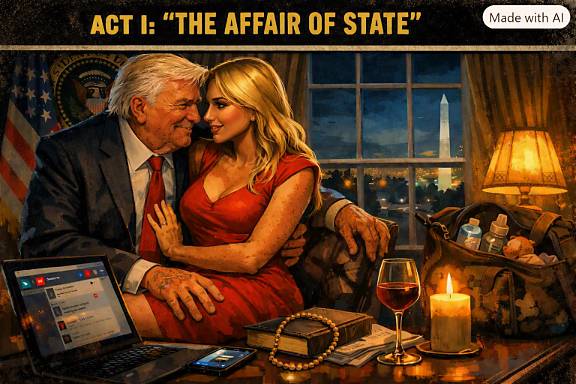
Inside the Oval Office, President Randall Crump — an 80-year old, self‑absorbed populist with a spray‑tan sheen — flirts with his “chief tweet adviser and diaper bag carrier,” Natalie Sharp, a zealous media aide who believes divine destiny runs through cable ratings. Their late‑night “strategy sessions” blur the line between strategy and pillow talk.  “Natalie, this is a brilliant tweet to put on my Truth Social to the MAGA idiots who believe every word I say, ‘I live for you and everything I do is for you.’”  “No, Mr. President, that’s not for the people.  I wrote that just for you.”

President Crump is ready to speed around the drained Reflective Pool in a suped-up golf cart to show off the “Flag-Blue” plastic liner that was installed by a campaign donor.  “Wait, I need my Binkie.  Where’s Natalie?  “Don’t worry the Secret Service agent assures him, “She’s right behind you in the trunk of the Beast
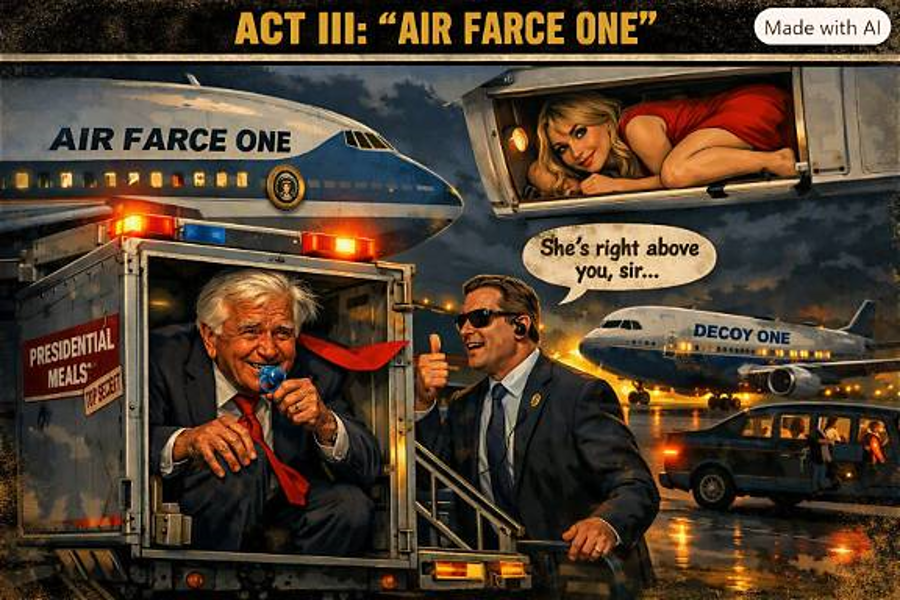
President Crump is informed that Iranians are threatening to shoot down Air Force One, so he pretends to board the plane but sneaks into a catering container to be secretly whisked to another plane.  Meanwhile he doesn’t inform the press corps or his Cabinet members that they will be flying on the targeted Decoy plane.

President Crump is ready for take-off in his alternate plane, but says, “Wait.  I need my Binkie.  Where’s Natalie.

The Secret Service agent informs him, “She’s right above you sir.  She stored herself in the overhead luggage compartment of the plane.”
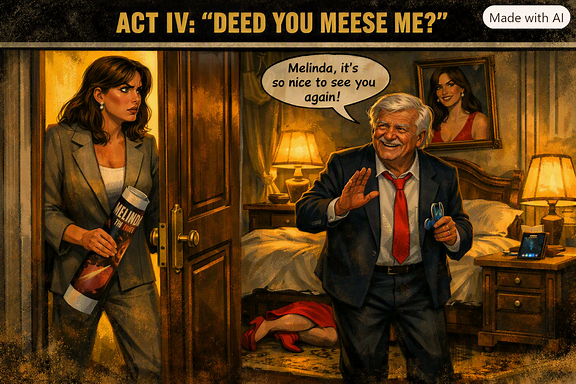
First Lady Melinda Crump returns from a promotion tour for her movie, Melinda: The Movie.  She is appalled to find that her position of First Lady is being usurped by Natalie.  Normally, she never goes near her husband’s bedroom, but she is upset and storms up to the room.  It is locked.  “Open up,” she demands.

“Quick Natalie, hide.” Crump screams and Natalie hides under the bed.

He opens the door.  “Melinda, it is so nice to see you, again.”

“Save your lies for the MAGA morons who still believe them.  Where is the woman I’ve been hearing so much about on the news?”

“Stormy Daniels?”

“No, not her, a new one.”

“Melinda, you know that I only have eyes for you.”

“Yes, but you’ve got hands for everyone else.  Those tiny little hands of yours grab everything in sight.”
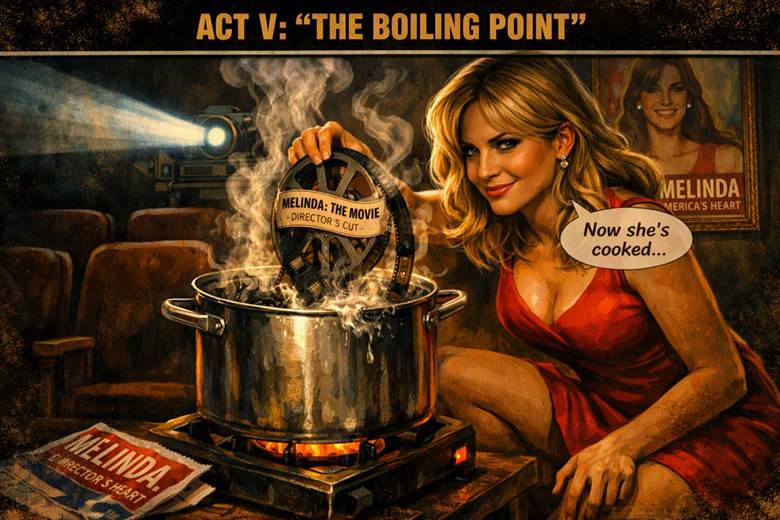
When Crump ghosts her for a photo‑op with First Lady Melinda, Natalie snaps. She sneaks into the White House screening room, finds the reel of Melinda: The Movie — a syrupy biopic commissioned for campaign propaganda — and boils the celluloid in a silver stockpot. Steam rises, the film curls, and Natalie whispers, “Now she’s cooked.”
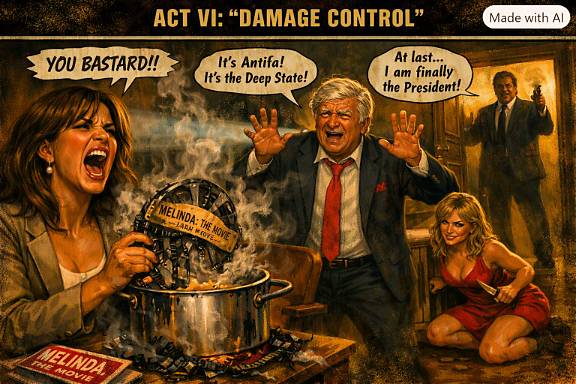
Melinda discovers the melted reel and screams so loudly it can be heard throughout the White House. Crump walks into the room and blames the deep state, Antifa, Communists, Venezuelan fishermen, Iranians, Jeff Shlepstein, and former President Boden. Melinda blames him and accuses him of cheating on her, which he denies.  Suddenly Natalie crawls out of a kitchen cabinet with a long knife.  President Crump and Melinda raise their hands, when Vice-President Couchpoker bursts in and shoots them all.  “At last,” he cries, “I am finally the President.”

The End.

Peace and Love, and all of the above,

Earl

A Balancing Act

False balance is one of the quiet distortions in modern media — a mistake that looks fair on the surface but bends reality underneath. It happens when journalists present two sides of an issue as if they carry equal weight, even when one side is supported by overwhelming evidence and the other is propped up only by belief, ideology, or misunderstanding.

The result is a counterfeit symmetry: a debate that appears evenly matched but isn’t.

Before 1987, the Fairness Doctrine required broadcasters to present contrasting viewpoints on public issues. It didn’t demand equal time, only reasonable balance. When the doctrine was revoked, the media landscape shifted. Talk radio surged, cable news hardened into ideological lanes, and the old “two sides” format became a default — even when the evidence didn’t justify it.

This created fertile ground for false balance. A fringe claim could be elevated simply because a producer wanted a “debate.”

Science doesn’t operate on opinion; it operates on evidence. When a topic like climate change, evolution, vaccine safety, or the shape of the Earth is presented as a 50/50 dispute, the audience receives a distorted picture. The fringe position gains legitimacy it hasn’t earned. The evidence‑based position is dragged down into a false equivalence.

Neil deGrasse Tyson’s formulation is the cleanest correction: all ideas deserve to be heard, but they don’t deserve equal time. Hearing an idea is free speech. Elevating it to parity with established science is misinformation.

False balance doesn’t just confuse people; it slows public understanding. It creates the illusion of controversy where none exists. It gives fringe movements a megaphone they couldn’t build on their own. And it undermines trust in institutions that rely on evidence, not ideology.

The antidote is simple: weight coverage according to evidence. Not according to loudness, not according to political pressure, and not according to the outdated notion that every issue has two equal sides. Some issues have one side supported by mountains of data and another supported by anecdotes or conspiratorial thinking.

Fairness means representing reality accurately — not pretending reality is a debate.

Peace & Love, and all of the above,

Earl

Exit Velocity


I got an e-mail from my high school alumni association asking me to submit an article on where my life has gone since High School. Here’s what I submitted.

Escape Velocity — How I Survived Catholic School and Became a Proud Atheist
I spent thirteen years in Catholic school — thirteen years of uniforms, catechism, and guilt as a second language. If you ever wondered what it’s like to grow up under constant moral surveillance, imagine being told that God is watching you and Brother Luke Martin has binoculars.
So when Christ the King high school asked alumni to write about “where we are today,” I thought: Spiritually? I’m off-campus, way off campus.
My family’s devotion was inherited, not chosen — like a family heirloom you’re expected to wear even if it clashes with your outfit. Faith was comforting, sure, but also confining. Certainty has a way of wrapping around you like a warm blanket that slowly turns into shrink-wrap.
We were taught that doubt was dangerous. I later realized doubt is just healthy curiosity.
My escape wasn’t dramatic — no lightning bolts, no slammed doors. It was more like discovering that “critical thinking” wasn’t a sin after all. I realized the universe didn’t need a hall monitor.
I remember the first time I said aloud, “I don’t believe in God.” I braced for thunder, lightning, or at least a pop quiz from God. Nothing happened. The world kept spinning. That’s when I knew I’d achieved escape velocity.
Leaving faith behind was gradual, not rebellious. I didn’t trade hymns for heavy metal or start wearing black. I just stopped outsourcing my conscience. Curiosity replaced doctrine, and morality stopped being a checklist as I journeyed from Agnosticism to full-blown Atheism.
Turns out, you can be kind, honest, and decent without divine supervision — though you do lose access to guilt as a motivational tool.
Atheism didn’t erase morality; it clarified it. I learned that empathy doesn’t need commandments, and reason doesn’t need miracles. My ethics now come from people, not ancient parchments.
And honestly, life’s simpler when you don’t have to explain why an omniscient being needs weekly reminders that you’re sorry.
Catholic guilt, though — that’s the souvenir that never fades. It’s like a spiritual tattoo: invisible, indelible, and occasionally itchy.
To the students still navigating those hallowed halls of a Catholic high school: think freely, question deeply, and define belief for yourself. Faith, doubt, and reason aren’t enemies — they’re just different ways of asking the same question.
And if this essay somehow gets printed in the alumni newsletter, I’ll consider it my first miracle.
Sincerely,
Harold Earl Paulson, Class of 1966.

I haven’t heard back from them, yet.

Peace & Love, and all of the above,

Earl