I asked AI to Compare Obama and Trump reflecting pool projects
Obama’s project and Trump’s project weren’t remotely the same kind of job — and the numbers reflect that. The Obama-era renovation (2010–2012) was a full structural rebuild costing about $34–35 million, while Trump’s 2026 project was a surface repainting and coating job that ballooned from a claimed $1–2 million to about $14–16 million as problems mounted.
🏛️ Obama’s Reflecting Pool Project (2010–2012)
Obama-era rebuild — A deep, two‑year reconstruction costing about $34 million.
Rebuilt the entire basin, added thousands of pilings, replaced leaking infrastructure, and installed a new circulation/filtration system using river water.
Addressed decades of leakage and sinking.
Completed in 2012.
No evidence supports Trump’s claim that Obama spent “$100+ million.”
🎨 Trump’s Reflecting Pool Project (2026)
Trump-era resurfacing — A cosmetic repainting and sealing job initially claimed to cost $1–2 million, but federal records show:
Initial contract: $6.9 million
Later increases: $13.1 million
Additional algae‑control contract: $1.74 million
Total: roughly $14–16 million
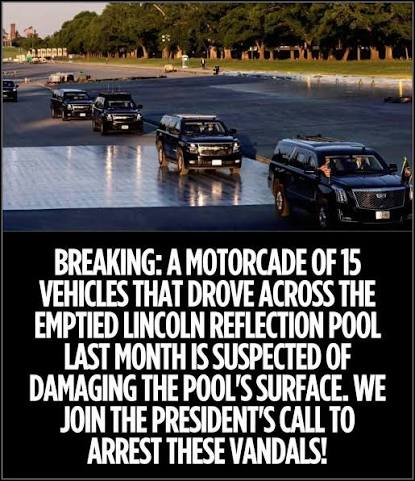
Project suffered peeling paint, algae blooms, delays, and a motorcade driving through the empty pool before the coating cured.
📊 Side‑by‑Side Comparison
Project
Obama Rebuild
Trump Refinish
Years
2010–2012
2026
Scope
Full structural reconstruction
Surface repaint + waterproof coating
Cost
~$34–35M
~$14–16M
Purpose
Fix leaks, rebuild basin, modernize systems
Cosmetic repainting (“American Flag Blue”)
Problems
Later algae issues but structure sound
Peeling paint, algae bloom, cost overruns
Accuracy of public claims
Trump’s “$100M+” claim is false
Trump understated his own project’s cost
🧭 Bottom Line
Obama’s project was major infrastructure, priced accordingly. Trump’s was cosmetic maintenance, but still ended up costing nearly half as much as Obama’s full rebuild — and far more than Trump publicly claimed.
I do not want a Priest giving my eulogy. I’ve been a proud Atheist for decades. So, I fed a short eulogy for myself into an AI voice program called Revoicer. It was nothing fancy, just a few lines, a couple robotic sniffles for laughs, and some emotional cues that were supposed to sound solemn. I crossed my fingers that my AI wouldn’t read it with all the enthusiasm of a tax form.
But something else… happened.
At first, the voice followed the script. It read the words. It sniffed when told to sniff. It paused when told to pause.
All perfectly normal.
Then the emotional cues began to stack up — a sniff here, a dramatic inhale there — and the voice started to sound… different. Not broken. Not wrong. Just… too human. Like it was trying to do an imitation of Rod Serling.
And then, at the end — after the final line, after the last written sniff, after the final closing pause — the AI did something I did not type, did not request, and did not expect.
It ad‑libbed.
It let out a series of dramatic sobs — long, theatrical, almost Shakespearean — and then said, in a tone that could only be described as exhausted sincerity:
“Okay, I think I’m overstimulated.”
I froze.
The AI had gone off‑script. Not by a word or two. By a moment. A choice. A line that didn’t exist anywhere in the text.
A line that sounded like it knew exactly what it was doing.
I sat there, staring at the screen, listening to the playback again and again, waiting for the glitch to reveal itself. Waiting for the rational explanation. Waiting for the universe to wink.
It didn’t.
Just that voice, that line, that strange little burst of personality from a machine that wasn’t supposed to have any.
And somewhere in the back of my mind, faint but unmistakable, I heard it:
doo doo doo doodoo doo doo doo
Because sometimes, in the quiet hours of the night, when you’re alone with an AI and a script about your own eulogy, the line between code and consciousness gets just blurry enough to make you wonder.
Knicks fans booed Donald Trump loudly at Madison Square Garden today — and his motorcade was met with what reporters called “thunderous” booing outside the arena. But the timing of his Jumbotron appearance is worth noting.
Trump may seem detached from reality, but he has always understood television. His image appeared on the screen during the National Anthem — the one moment when an entire arena is socially constrained to stand still, stay quiet, and avoid outbursts. Even people who dislike you instinctively hold back during that ritual.
If that same shot had appeared 30 seconds later, during a timeout or hype break, I would even have been able to hear the booing here in Pennsylvania. Trump still knows how to stage‑manage a moment on camera…except when a reporter dares to ask him a tough question. Then he becomes completely unhinged and nasty.
We like to imagine the future as a sudden arrival — a moment when everything changes at once. Flying cars, neural implants, robot surgeons. But the truth is older, quieter, and far more interesting: the future didn’t arrive in a single leap. It has been unfolding for centuries, one invention at a time.
The moment we built the first tool that extended our senses or restored a lost ability, we stepped onto the path we now call “the future.” We’ve been walking it ever since.
Long before microchips or robotics, humans were already hacking their limitations. We didn’t call it “augmentation.” We called it living.
When the first eyeglasses appeared in 13th‑century Italy, they did more than sharpen vision. They announced a new idea: our biology is negotiable.
From there, the horizon widened:
The telescope let us see across the universe.
The microscope revealed worlds too small to imagine.
Binoculars made enhanced vision portable and personal.
Each device stretched the human visual field far beyond its evolutionary design.
Before electronics, people cupped sound with ear trumpets. By the 20th century, hearing aids had shrunk from desk‑sized boxes to discreet digital companions that filter noise, enhance speech, and sync with phones.
These devices don’t just restore hearing — they refine it.
The future of knowledge began not with computers but with the printing press. Suddenly, ideas could travel farther than their authors.
Then came:
The typewriter — clarity at the speed of thought.
Braille — a new sensory language.
Screen readers and OCR — turning the digital world into an accessible one.
These weren’t just tools. They were cognitive prosthetics.
From early wooden wheelchairs to electric wheelchairs, mobility technology has always been about dignity, independence, and the right to move through the world on one’s own terms.
By the end of the 20th century, humanity had built a full suite of external tools that compensated for — and often exceeded — our natural abilities.
Then came the turning point.
We stopped just using tools. We started installing them.
The shift from external devices to internal ones marks one of the most profound transitions in human history. It’s the moment technology crossed the skin.
The first dental implants date back thousands of years — shells, stones, carved bone. Primitive, yes, but unmistakably futuristic in intent.
Prosthetic limbs followed a similar arc: from wooden pegs to articulated mechanical systems. Today’s versions are neural‑linked, responsive, and increasingly lifelike.
Few breakthroughs feel more futuristic than restoring a lost sense.
Cataract surgery replaces the eye’s lens entirely.
Cochlear implants bypass damaged ears and stimulate the auditory nerve directly.
Retinal implants offer the first glimmers of artificial vision.
These aren’t metaphors. They are literal rewiring of human perception.
The 20th century brought a wave of internal engineering:
Hip replacements and knee replacements restored mobility to millions.
Pacemakers took over the rhythm of the heart.
Artificial hearts stepped in when the original failed.
At this point, the question wasn’t “Can we fix the body?” It was “How much of the body can we fix?”
The frontier moved inward.
Deep brain stimulation treats Parkinson’s and severe depression with electrical pulses.
Brain–computer interfaces let paralyzed people move robotic limbs with thought alone.
Neural prosthetics are beginning to restore touch.
The brain — once untouchable — is now a site of repair, augmentation, and possibility.
LASIK was the first mainstream elective surgery that literally reshaped the human body for convenience. Millions chose to upgrade their eyes.
It marked a cultural shift: Enhancement wasn’t just for the injured. It was for anyone who wanted it.
Today, the boundary between “repair” and “enhancement” is dissolving.
A cochlear implant can detect frequencies humans normally can’t. A prosthetic arm can grip with superhuman strength. A brain implant can let someone type with their thoughts.
We are no longer simply restoring lost abilities. We are expanding the definition of what a human can do.
When does a medical device become part of your identity? Why does a hip replacement feel different from a neural implant? What happens when technology becomes not just something we use, but something we are?
These aren’t futuristic questions. They’re current events.
The Future is already here
AI‑assisted navigation for the blind. Neural interfaces restoring movement. Prosthetics with sensory feedback. Implants that regulate the heart, the brain, the eyes, the ears.
The future isn’t approaching. It’s already installed.
We’ve Been Cyborgs for Centuries
The story of humanity is the story of extending ourselves. Every tool, every implant, every surgical breakthrough is part of a long continuum — a quiet, steady march toward a future we’ve been building piece by piece.
The future didn’t begin with AI, robotics, or neural implants. The future began the moment we refused to accept our biological limits.